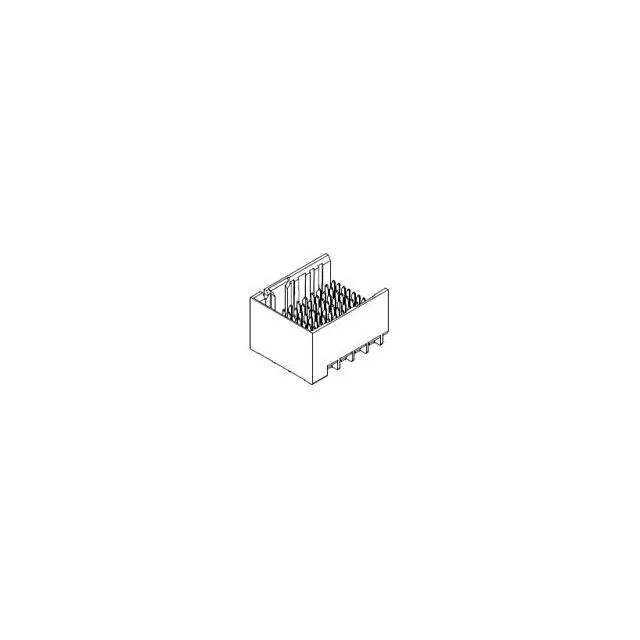
Backplane Header for 48 Differential-Pair Channels
The Molex Impact 1703351217 is a 144-position backplane header from the Impact 170335 series, arranged as 12 rows by 12 columns. It is a male-pin, press-fit connector designed for high-density differential-pair routing — the contact layout is mapped to 48 differential pairs, meaning each pair occupies a column of adjacent signal pins with a ground shield structure built into the connector geometry. This is not a general-purpose wire-to-board header; it is a signal-integrity-optimized interconnect for 25+ Gb/s backplane channels where crosstalk and impedance control are the governing constraints. The press-fit termination eliminates solder — the compliant pin cold-forms into the plated through-hole, which avoids thermal stress on the PCB and supports rework of individual pins or entire connectors in a backplane assembly.
144 Positions, 12 Rows — What the Density Means for Board Layout
The 144 positions are fully loaded — every pin position in the 12x12 grid is populated. That density drives the PCB footprint: the backplane must route 48 differential pairs through the connector zone, each pair requiring its own via pattern and breakout trace. The press-fit pin footprint is standardized in the Impact series; the plated through-hole diameter and pad size are defined in the product drawing and must match the PCB supplier's drill stack. The 12-row configuration is the full-width variant of the Impact header. A 6-row version exists for lower-density backplanes, but the 12-row version is the one to specify when the channel count requires the full column width.
Press-Fit Termination and Backplane Assembly
No solder wicking, no flux residue, no thermal cycle on the board. The through-hole diameter tolerance is tighter than for a soldered pin; verify the PCB supplier can hold the specified drill size before committing the layout. The mating interface is keyed by the connector shell geometry — no polarization options, so the header and receptacle must be oriented correctly in the backplane and line-card stack-up.