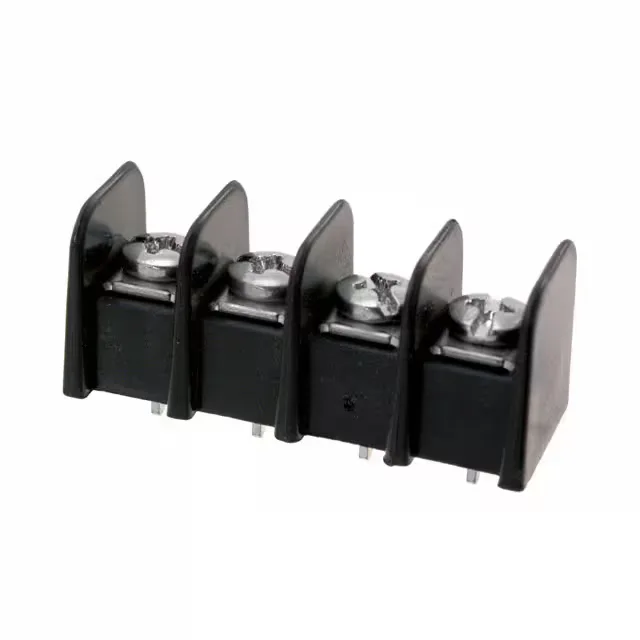
What it is
The Molex 387206304 is a 4-circuit member of the Beau 38720 barrier strip family, finished in black with a dual-wall barrier body rated 15 A per circuit at 300 V and operating from -40°C to 100°C. Top termination is screw clamp accepting 14-22 AWG conductors; the bottom terminates to a through-hole PC pin for board-level mounting — a common layout for control-panel feed-throughs where field wiring enters from above and the PCB receives the ground reference below. The housing is thermoplastic rated UL94 V-0, meaning it will not sustain a flame once the ignition source is removed — a baseline requirement in most industrial enclosure builds.
What the ratings mean
0.375" pitch (9.53 mm) sets the spacing between wire entries and the corresponding hole-to-hole footprint on the PCB. Check that your panel cutout and board routing density accommodate the 4-circuit span before committing. 15 A per circuit at 300 V is the contact limit. The 14-22 AWG wire gauge range aligns with this current rating — a 14 AWG run at 15 A stays within normal ampacity without derating. For a continuous-duty motor branch at full load, verify the enclosure ambient does not push the conductor or the contact past its thermal limit. Screw-clamp entry at the top means the conductor is trapped under a steel screw with zinc clear chromate finish — the plating resists corrosion at the termination interface. Torque each screw to the datasheet value; a loose screw at 15 A runs hot and the creep gap grows with each thermal cycle until the joint opens or arcs. Operating range of -40°C to 100°C covers the temperature extremes typical in industrial enclosures, near-machine panels, and outdoor enclosures without climate control. The thermoplastic body handles the range; the limiting factor at high ambient is still the contact current and wire ampacity.
Where this class is used
Barrier strips like the 38720 series appear in industrial control panels, power distribution blocks, HVAC equipment, and machine-tool enclosures — anywhere you need to land multiple field wires under a single termination point with visual isolation between circuits. The dual-wall barrier prevents accidental shorting between adjacent conductors when the panel is under maintenance.
