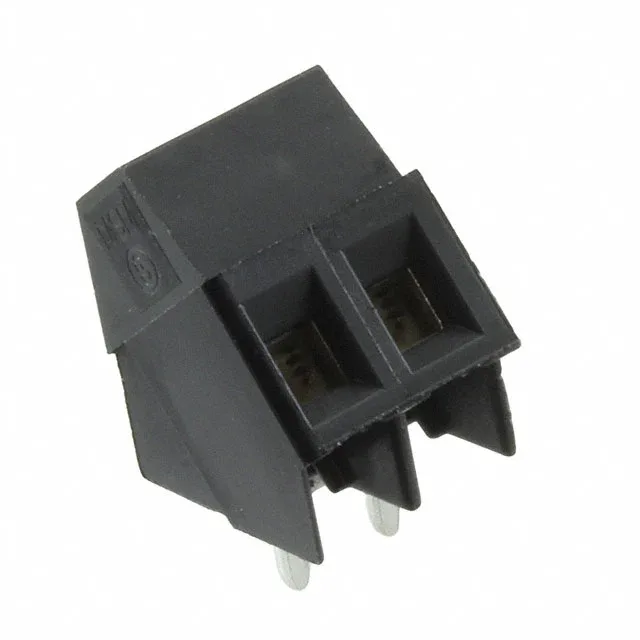
The Molex Eurostyle 39890 398900402 is a 2-position terminal block on a 0.197" (5.00 mm) pitch, designed for through-hole PCB mounting. The black polyamide housing is rated for continuous operation up to 105°C, and the contacts are copper with tin plating. This is the 2-position member of the Eurostyle 39890 series, commonly used in industrial control, power supplies, and building automation where a moderate-density, field-wireable interconnect is needed.
The 17.5 A current rating is solid for a 5.00 mm pitch terminal block, but that figure assumes the full 105°C operating limit and a single level fully loaded. Every amp makes heat — in a warm cabinet or with adjacent blocks ganged, the real current capacity drops. The 300 V rating gives enough creepage for most industrial signal and low-power distribution circuits, but the 35° wire entry angle means the wire exits at a slope, not straight up — check your enclosure lid clearance and the direction of the neighbouring components before routing. The screw rising-cage clamp accepts 12-30 AWG, which covers everything from a 12 AWG power feed down to a 30 AWG sensor wire. The copper-nickel-plated screw and clamp resist corrosion in humid environments, and the tin-plated contact surface is a good match for tinned or bare copper wire. No special tooling needed beyond a standard screwdriver — field re-termination is straightforward.
The closest same-family alternative is the Eurostyle ESE 39544 series — the 395443005 (5-position) and 395443008 (8-position) at a 0.200" (5.08 mm) pitch. The 398900402 carries a slightly higher current rating (17.5 A vs 15 A) and uses a 35° angled wire entry, while the 39544 series wires horizontally with the board. If your board layout and enclosure allow horizontal wire routing, the 39544 gives more positions per block; if you need the angled exit for clearance, the 39890 is the right fit. Both use the same rising-cage clamp and accept 12-30 AWG, so termination hardware is interchangeable. The pitch difference (5.00 vs 5.08 mm) is small but not negligible — the PCB footprint must match the specified pitch exactly.