What the ratings mean for the fit
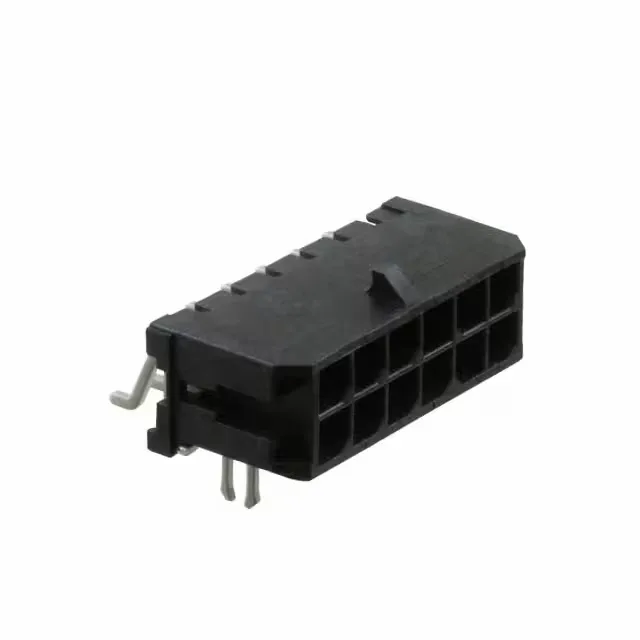
The 430451208: The contact plating split is the detail that trips people up on Micro-Fit 3.0 sourcing: the mating face carries 30.0 µin (0.76 µm) gold over nickel, while the solder-post side is 100.0 µin (2.54 µm) tin. The gold mating finish supports repeated reconnect cycles — the series is specified for the higher mating-cycle durability that power interconnects in the field require. The tin post is sized for solderability and long-term shelf storage, not for the mated interface. The four-wall shroud and locking ramp are what make this a harness-grade header: the shroud encloses the entire mated interface, and the ramp locks the receptacle housing positively so it does not back out under vibration. This is not a free-floating board-level header — it is designed to lock into the matching housing before the harness leaves the assembly station. The board-lock feature anchors the header to the PCB pad during SMT reflow, which matters for right-angle headers where the footprint can shift under solder paste reflow forces.
What the 12-position count decides
12 positions dual-row at 0.118 inch (3.00 mm) pitch gives a square grid layout — the board layout engineer routes two trace pairs per row with adequate keep-out around the header body. The insulation height is 0.290 inch (7.37 mm), which sets the standoff from the board surface. SMT right-angle termination on a 12-position dual-row header requires attention to the footprint — the right-angle bend means both rows terminate on the same PCB side. The 3.00 mm row spacing (equal to the pitch, giving a square grid) allows a dense but orderly routing channel through the header body. Board-lock pegs on the header body fix the X-Y position during reflow, but the right-angle orientation means coplanarity of the solder tails must be verified against the PCB pad design.
Where this class is used
Micro-Fit 3.0 headers sit in board-to-wire power interconnects across automotive control modules, industrial automation drives, medical instrumentation, and telecom infrastructure — anywhere a 3.00 mm pitch power header must lock positively and survive repeated harness mate/unmate cycles at up to 8 A per circuit. The shrouded interface and locking ramp are standard for in-cabinet harness routing where vibration or cable pull could otherwise unseat the connector. ROHS3 compliance makes the series suitable for European automotive and industrial OEM builds.
