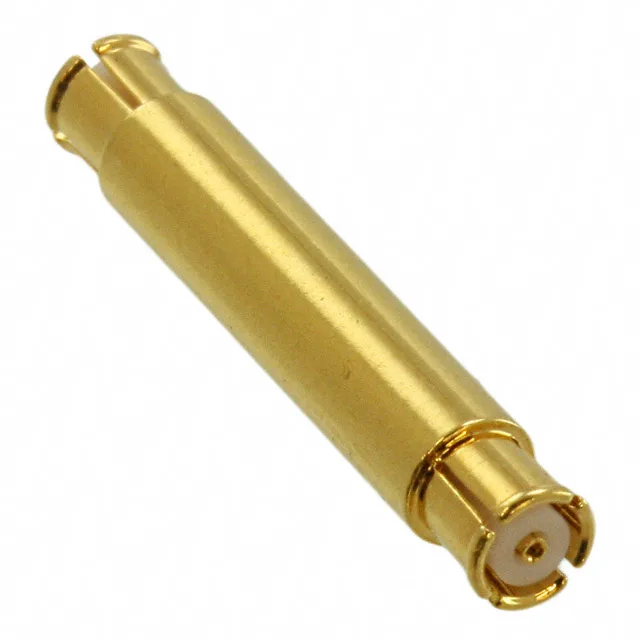
SMP Jack-to-Jack Adapter, 50 Ohm, 40 GHz — the Gender-Changer for SMP Test and Interconnect Chains
The Molex 0734153350 is a straight SMP jack-to-jack adapter, female-to-female, from the 73415 series. It converts between two SMP female ports within the same series — a gender-changer, not a series-to-series transition. The adapter is rated for 50 Ohm impedance systems and specified to 40 GHz, placing it in the upper band of SMP interconnect components. Both ends use the standard SMP snap-on fastening, so it mates directly with any SMP male plug without additional hardware. The body is machined from beryllium copper with gold finish, and the centre contacts are gold-plated beryllium copper as well — a material choice that keeps contact resistance stable across repeated matings at microwave frequencies. The dielectric is PTFE, which holds a consistent dielectric constant through the rated band.
40 GHz and 50 Ohm — What the Bandwidth Rating Means for Signal Integrity
The 40 GHz maximum frequency is the defining spec here. A generic SMP adapter might be rated to 18 or 26.5 GHz; this one holds its impedance profile through the full K-band and into the lower V-band. In practice, that means the adapter introduces minimal return loss and insertion loss ripple up to 40 GHz — it won't become the weak link in a 40 Gbps or 28 Gbaud serial link. If your system is 75 Ohm (legacy video or broadcast), this is the wrong adapter. The straight body orientation keeps the signal path in-line, which avoids the phase-length mismatch that a right-angle adapter would introduce in a differential pair or a time-domain reflectometry setup.
Free-Hanging Inline Mount — No Panel Cutout, No PCB Footprint
The adapter is free-hanging (in-line) with no mounting flange or panel hole required. It sits in the cable run as a mechanical and electrical bridge between two SMP male-terminated cables or board-mounted SMP jacks. The beryllium copper body and snap-on retention mean it can handle the insertion and withdrawal forces of repeated blind-mate connections without deforming. For a test harness or a modular RF assembly where you need to break a signal path for calibration or reconfiguration, this adapter lets you insert a female-to-female link without modifying the board or panel layout.