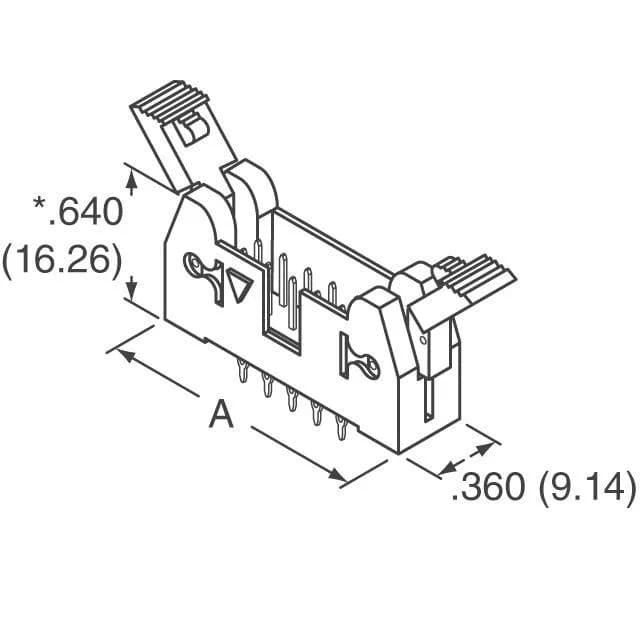
The FCI 10080054-085LF is a 20-position, dual-row male header in the Quickie series, built board-to-cable/wire style with a 0.100" (2.54mm) pitch and full shrouding on all four walls. Contacts are gold-plated at 30.0 µin (0.76 µm) on the mating face, built on a phosphor bronze alloy substrate — the combination that gives this class of header its durability against repeated mating cycles. Termination is press-fit combined with solder — the press-fit tail adds mechanical retention in the plated through-hole before solder reflow, which matters for any build where hand-solder touch-up or rework access is a constraint. Short latch lock/eject hooks on the mating interface provide positive retention while allowing single-handed disengagement — a practical feature for any field-service or test-fixture context where the cable side needs to break away cleanly.
Typical applications
The Quickie series is a long-established I/O header family used as the board-side termination point in wiring harness assemblies across industrial automation, instrumentation, and legacy interface applications. The board-to-cable/wire style means this header lives at the PCB edge where the harness leaves the board — the 4-wall shroud and keying slot are there precisely because the harness mate happens in a vibration-prone environment where accidental polarity reversal is a field failure mode. At 20 positions in a dual-row layout, this header sits in the upper-middle of the Quickie range — dense enough for multi-signal bus routing but not so dense that individual contact replacement becomes impractical. The square pin contact shape accepts the standard square post in the matching receptacle.
Sourcing posture
The 10080054-085LF carries an Active product status — quoted to order against BOM quantities with no stated last-time-buy date on this listing. Confirm the exact position count against your BOM line before committing — the Quickie series spans multiple position counts at the same 0.100" pitch, and the shroud/keying configuration on the -085LF variant is specific to that position count. The mating half must carry the matching polarization key.