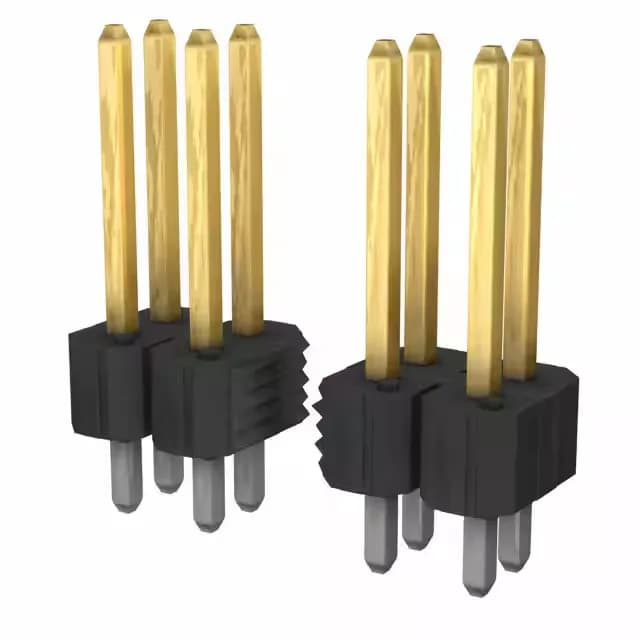
What this connector is
The Amphenol FCI 86832-120HLF is the 20-circuit member of the BERGSTIK II series — a dual-row, 0.100-inch (2.54 mm) pitch male pin header designed for board-to-board stacking in industrial automation and instrumentation applications. The header carries square male pins in a through-hole push-pull configuration, with all 20 positions populated and black UL94 V-0 rated insulation. Contact material is phosphor bronze, and the mating face is finished in either pure gold or Amphenol FCI's GXT (Gold eXTended) plating to 30 µin (0.76 µm) — a thickness that provides reliable fretting resistance in addition to low contact resistance at first mate.
Key ratings and what they mean
The 5 A per contact rating handles both signal-level and moderate power bus duties. The governing factor for continuous current is the contact plating grade — 30 µin gold or GXT on the mating side — which maintains contact integrity across repeated mating cycles rather than acting as a current-carrying upgrade. If the application demands sustained power rather than repeated reconnect cycles, the tin-plated variant of this series carries the same pitch and footprint but a different plating grade; confirm which finish is quoted on the order line. Voltage rating is 110 V — adequate for signal, control, and low-voltage power bus within industrial enclosures, but not suited for mains or high-voltage distribution. The push-pull fastening type means the mating retention relies on the pin-to-socket interference fit rather than a screw-lock thread; in high-vibration environments, confirm whether a friction-latch header alone meets the retention requirement or if a compatible latching receptacle is needed on the mating half. The 0.325-inch (8.26 mm) mating contact length and 0.525-inch (13.34 mm) overall pin length, with a 0.100-inch (2.54 mm) post length and 0.100-inch (2.54 mm) insulation height, define the stack geometry for board-to-board configuration. These dimensions set the insertion depth into the mating receptacle and the standoff above the board surface — both critical for the z-height budget in tight board-stacking layouts.