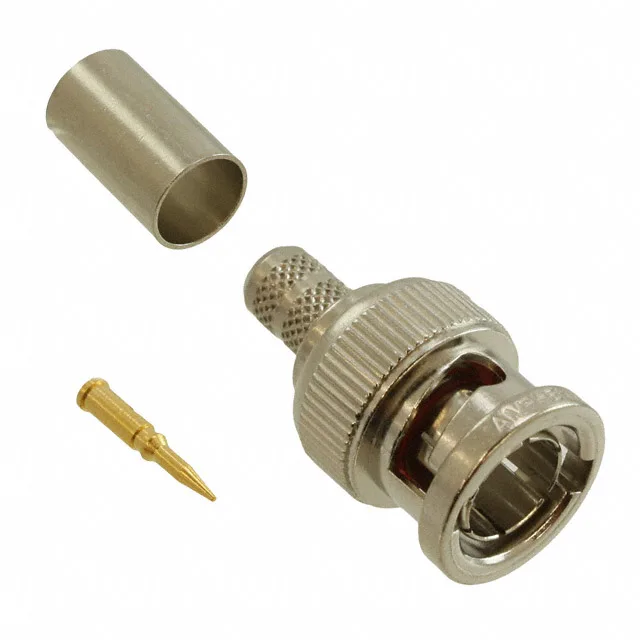
The 031-71008-1RFX: It is the 75 Ohm variant in Amphenol's BNC line — the impedance is the defining spec here, not the connector style. The nickel-plated brass body resists corrosion, and the POM acetal dielectric maintains consistent impedance across the temperature swing. This is a field-serviceable connector — the crimp termination for both centre contact and shield means you terminate it on the cable, not at the factory.
This plug is spec'd for RG-59, RG-59B, RG-62, RG-140, RG-210, and Belden 8241, 8263, 8279, 9209 cable groups. That covers the common 75 Ohm coax types for video and data — RG-59 for CCTV and composite video, RG-62 for Arcnet and IBM 3270, and the Belden numbers for broadcast and security. The centre contact is crimped onto the conductor, the ferrule crimps over the braid shield, and the body threads onto the ferrule. No soldering needed in the field. RG-6 cable is not in the listed cable groups. If your harness uses RG-6, this plug is not the correct fit — you would need a BNC designed for RG-6's larger dielectric diameter. Stick to the listed groups for a proper impedance match and crimp retention.
NRND Lifecycle — Plan Your Sourcing
That means the part is still available for existing production but is on a phase-out path. For new designs, look at Amphenol RF's current 75 Ohm BNC plug family — the impedance, cable group, and termination style are the matching criteria.
Signal Integrity at 2 GHz
At 2 GHz max frequency with 0.2 dB insertion loss, this connector holds its signal quality through the video band and into low-GHz data links. The gold-plated centre contact keeps contact resistance low over 500 cycles; the nickel body finish gives the shield a consistent ground path through the bayonet interface. For a 75 Ohm system running SDI, composite video, or baseband data up to 2 GHz, this plug meets the loss budget.