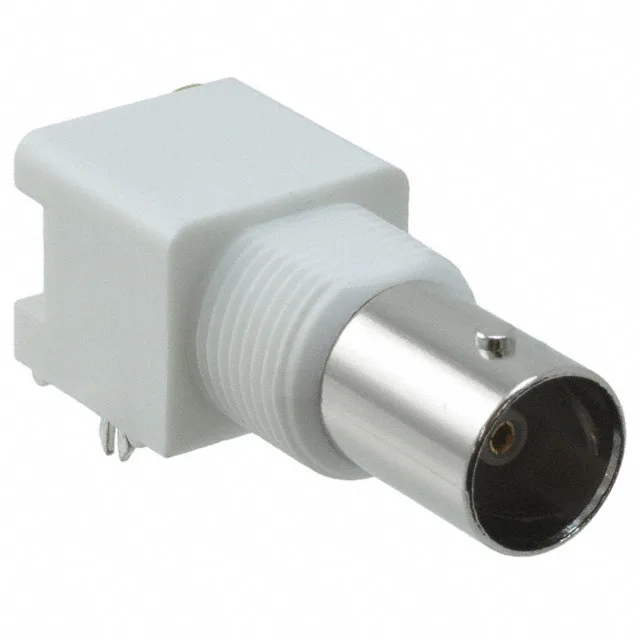
Board-Edge BNC for 75 Ohm Video and Data Links
The 031-71052-1010: The right-angle through-hole tails and front-side bulkhead nut let you launch a coax signal off the board edge and secure it to the panel in one assembly step.
75 Ohm BNCs are the standard interface for broadcast video (SDI), CCTV, baseband data, and test equipment where the line impedance is 75 Ohm. The 1 GHz ceiling covers standard-definition and most high-definition serial digital video — 3G-SDI at 2.97 Gbps is beyond this connector's bandwidth, but 270 Mbps SDI and 1.485 Gbps HD-SDI fit comfortably within the 1 GHz passband. The 0.2 dB insertion loss figure tells you the impedance match through the board launch is tight — a poorly matched BNC can add 0.5 dB or more at the top end of its band. The 500 mating cycles is standard for a BNC — this is a field-serviceable connector you can swap cables on without degrading the contact. It is not a high-cycle test port (that would need 5000+ cycles and a different plating grade), but for a panel-mounted video input or a piece of broadcast gear it will outlast the equipment's service life.
The connector mounts through a panel bulkhead (front-side nut) and solders into the PCB via right-angle through-hole tails. The shield termination is solder as well — you solder the braid to the body or to a ground plane on the board. The centre contact is a solder-cup termination — you tin the centre conductor of the coax, insert it into the cup, and flow solder. No crimp tool needed, which makes field repair straightforward. The bayonet lock mates with any standard 75 Ohm BNC plug; the keying is the bayonet slot, so a 50 Ohm BNC plug will physically mate but the impedance mismatch will degrade the signal above a few hundred MHz.