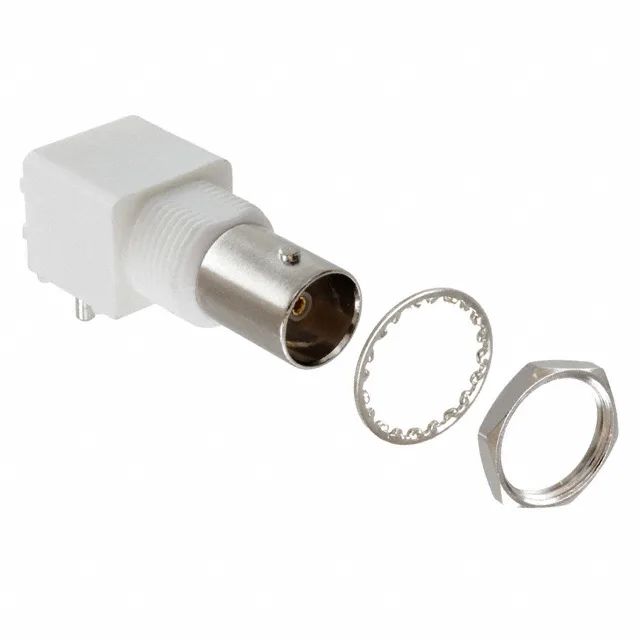
The 031-71052-10RFX: This is not the 50 Ohm BNC used in RF test equipment or telecom; the 75 Ohm interface uses a different dielectric bead and centre contact geometry, so it will not mate cleanly with a 50 Ohm plug without signal degradation. Rated to 1 GHz with 0.2 dB insertion loss, it covers the full NTSC/PAL video baseband and DOCSIS upstream spectrum. The connector ships as three pieces: the jack body with a zinc die-cast shell finished in nickel, a lockwasher, and a hex nut for the front-side bulkhead mount. A board lock on the PCB footprint anchors the connector against the torque of the bayonet mating cycle and the shear of a cable tug.
Mounting and Termination Sequence
50 Ohm vs 75 Ohm — Why the Impedance Matters
A 50 Ohm BNC (the more common variant) uses a smaller dielectric bead and different centre contact dimensions to achieve 50 Ohm characteristic impedance. Mating a 75 Ohm jack with a 50 Ohm plug creates an impedance mismatch at the interface, which causes a reflection and increases the insertion loss above the rated 0.2 dB. The physical difference is in the dielectric — the 75 Ohm version uses a larger polypropylene bead — so the two are not mechanically interchangeable. If the BOM calls for 75 Ohm, this is the correct jack; if the system is 50 Ohm throughout, look for a 50 Ohm BNC variant from the same series.