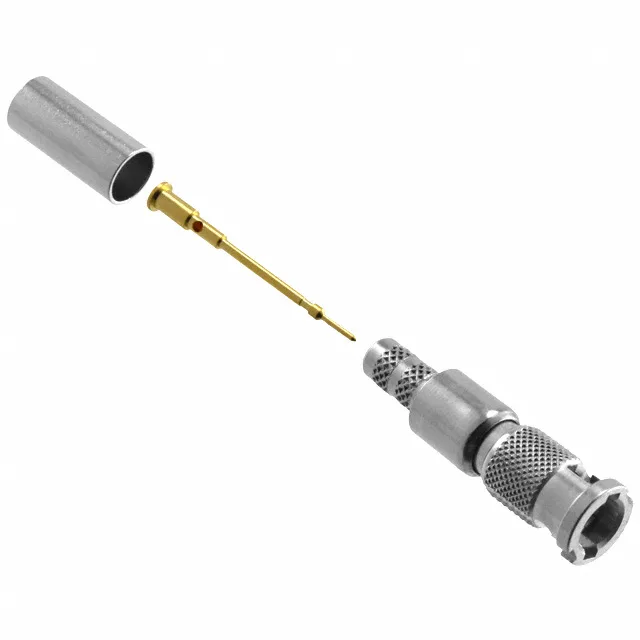
The 034-1037: The 75 Ohm impedance and 4 GHz frequency ceiling make this a natural fit for video distribution, broadcast, and CCTV applications where standard 50 Ohm BNCs would cause a mismatch.
What cables does it work with?
The 034-1037 is specified for RG-122, RG-180, RG-180A, RG-180B, RG-195, Belden 1855, and Belden 1865A cables. These are all 75 Ohm coax types with a nominal impedance match — using a different cable group will shift the impedance and degrade return loss. The crimp ferrule is sized for the outer jacket diameter of these specific cables, so swapping in a different coax means the ferrule won't bite correctly.
75 Ohm vs 50 Ohm — what's the difference?
This is a 75 Ohm connector, not the more common 50 Ohm BNC. The impedance is set by the dielectric geometry and center pin dimensions — a 75 Ohm BNC has a smaller center pin than a 50 Ohm version. Using a 75 Ohm plug on a 50 Ohm cable or vice versa creates a mismatch that shows up as ripple in the passband and reflected power. For video (composite, SDI, HD-SDI) and broadcast reference signals, 75 Ohm is the standard. For RF test equipment or radio, you'd want a 50 Ohm BNC.
Field life and temperature range
The PTFE dielectric holds its dielectric constant across that range, keeping the 75 Ohm impedance stable.