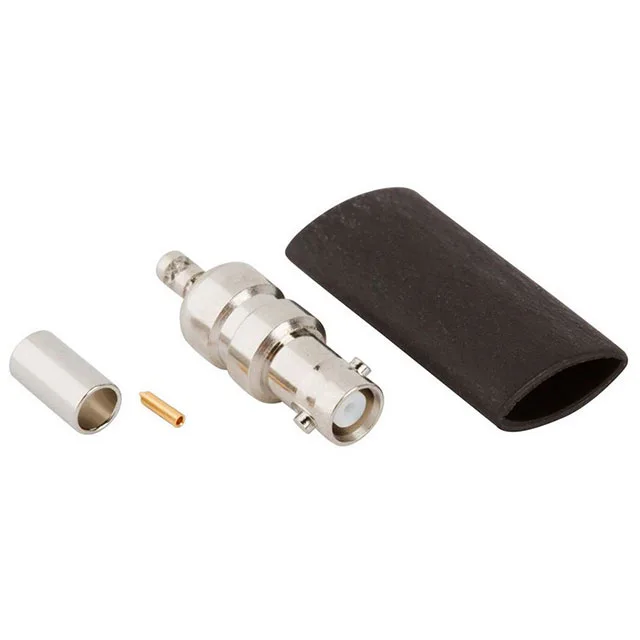
The 034-5020: This is the heavy-duty variant of the standard BNC — the HD body and bayonet lock handle more mating cycles and vibration than a consumer-grade BNC, while keeping the same quick-twist interface. The kit is designed for field or bench termination to flexible coax cables in the RG-174, 188, 188A, 316, LMR-100, and M17/119-RG174 groups. The shield is crimped via the included ferrule; the centre conductor is soldered into the contact. With an IP67 rating when mated to a compatible BNC HD plug, this connector is suited for outdoor antenna feeds, base station jumpers, test equipment in damp environments, and any RF interconnect that needs a weather seal without switching to a threaded interface.
The 6 GHz maximum frequency covers L-band, S-band, and most of C-band — enough for cellular backhaul, GPS antennas, Wi-Fi 6E access points, and instrumentation up to 6 GHz. Above that, the BNC HD interface geometry starts to introduce mode conversion; for higher frequencies you would step to an N-type or SMA. The IP67 rating — dust-tight and protected against immersion up to 1 metre for 30 minutes — is uncommon on a bayonet-lock BNC. Standard BNCs rely on the shell-to-shell contact for shielding but leave the interface unsealed. Here, an O-ring inside the bayonet groove seals the mating face, so this jack can live on an outdoor radio, a marine antenna, or a washdown station without a boot. The trade-off is a slightly higher engagement torque than a standard BNC; the bayonet lock still mates in under a quarter turn.
Cable Selection and Termination Notes
This kit accepts RG-174, RG-188, RG-188A, RG-316, LMR-100, and M17/119-RG174 — all flexible 50 Ohm cables with a nominal outer diameter around 2.5–3.0 mm and a solid or stranded centre conductor. The included ferrule is sized for these cable jackets; if you are using a thicker-jacket cable like RG-58 or LMR-200, the ferrule will not crimp properly and you need a different BNC kit. The centre contact is soldered, so use a rosin-core solder and a heat source that does not melt the PTFE dielectric (327°C melting point). The shield termination is crimp — strip the jacket to the specified length, fold the braid back over the ferrule, and crimp with a hex die sized for the ferrule OD. A proper crimp gives a gas-tight connection that meets the IP67 seal and keeps the shield impedance consistent through the transition.