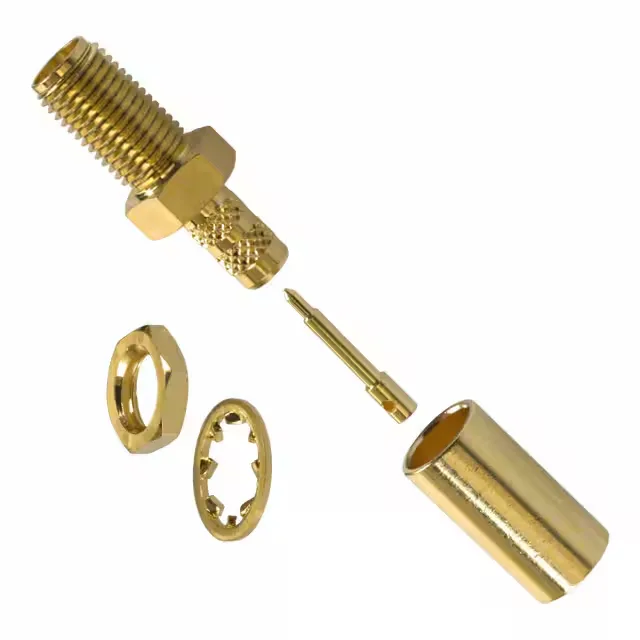
RP-SMA Gender Trap — Male Pin in a Jack Body
This reversal is the entire point: RP-SMA was designed to prevent accidental mating with standard SMA antennas on Wi-Fi equipment, where regulations require non-interchangeable connectors. The 132118RP is a 50 Ohm, single-port, threaded panel-mount connector rated DC to 12.4 GHz, with a gold-plated brass body and a PTFE dielectric. It ships as a 5-piece kit containing the connector body, a crimp ferrule for the shield, a solder cup contact, a lockwasher, and a bulkhead nut — everything needed for one cable assembly termination.
Cable Group and Termination — What Fits the Ferrule
The crimp ferrule is sized for RG-58, 58A, 58B, 58C, 141, 303, LMR-195, Belden B7806A, and 9907 coax cables — a common set of 50 Ohm flexible and semi-rigid types used in Wi-Fi, ISM-band, and test equipment interconnects. The centre contact is solder-terminated (beryllium copper, gold-plated), and the shield is crimped through the included ferrule. This hybrid termination (solder centre, crimp braid) is standard for RP-SMA cable assemblies: the solder joint gives a reliable DC path, while the crimp provides strain relief and consistent shield coverage.
12.4 GHz Ceiling — Not a Full 18 GHz SMA
The 132118RP is rated to 12.4 GHz maximum frequency, which is below the 18 GHz typical of a standard SMA connector. This is not a limitation for its intended use — 2.4/5 GHz Wi-Fi, 900 MHz ISM, GPS /L2, and most cellular bands sit well below 6 GHz. The 12.4 GHz ceiling comes from the RP-SMA interface geometry, which introduces a slight impedance discontinuity at higher frequencies compared to the standard SMA. Compare this to the Amphenol 132134-11, an SMA jack rated to 18 GHz — if your design needs the full 18 GHz band, that standard SMA part is the better fit. For sub-12.4 GHz work, the 132118RP covers the band with margin.
The threaded coupling (hex nut on the jack body) provides positive retention under vibration — no snap-on or bayonet that could loosen. The front-side nut mounting means the connector is installed from the outside of the panel, with the lockwasher preventing rotation during cable assembly torque.