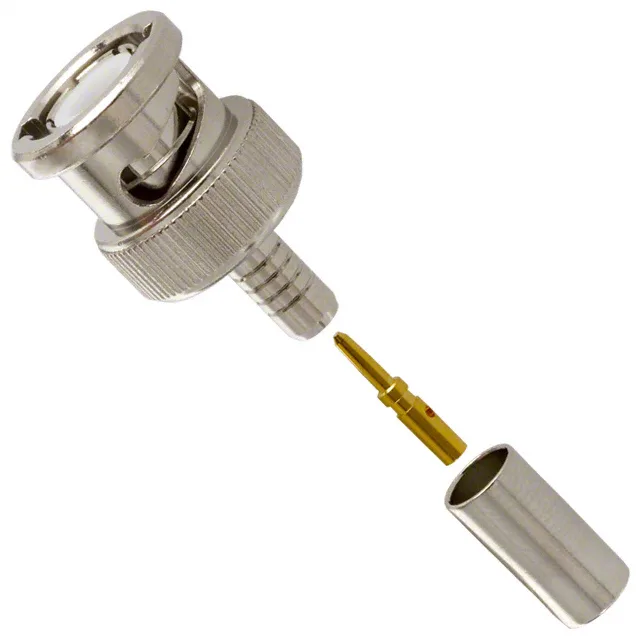
What This BNC Plug Terminates and How It Ships
The 31-320: The kit ships as three pieces: one connector body, one contact, and one ferrule — you supply the cable and the crimp die for the right hex size.
Cable Group Fit and Termination Reality
This plug is specced for RG-58 and its variants (58A, 58B, 58C), plus RG-141, RG-303, LMR-195, and the Belden B7806A/9907. That covers the common 50-ohm thin coax used in test leads, short cable assemblies, and lab interconnects. The shield crimps onto the cable braid; the center contact can be crimped or soldered. Match the crimp die to the ferrule OD — a standard RG-58 BNC die (typically 0.178 or 0.213 hex) seats the ferrule correctly. Wrong die, wrong crimp — the braid won't capture and the pull strength drops.
Key Specs for the RF Path
Insertion loss is 0.2 dB across the band, typical for a well-terminated BNC. Nickel-plated brass body resists corrosion in bench and field use.
The 31-320-RFX shares the same BNC plug body, cable group, frequency rating, and 500 mating cycles. The difference is the dielectric: the standard 31-320 uses PTFE, while the -RFX variant uses POM Acetal. For most RG-58 terminations below 4 GHz, the electrical performance is equivalent — the PTFE version is the original spec, the POM variant is a cost-optimized alternative. Both are active. Match the dielectric to your assembly's temperature range if you're regularly cycling above 100°C.