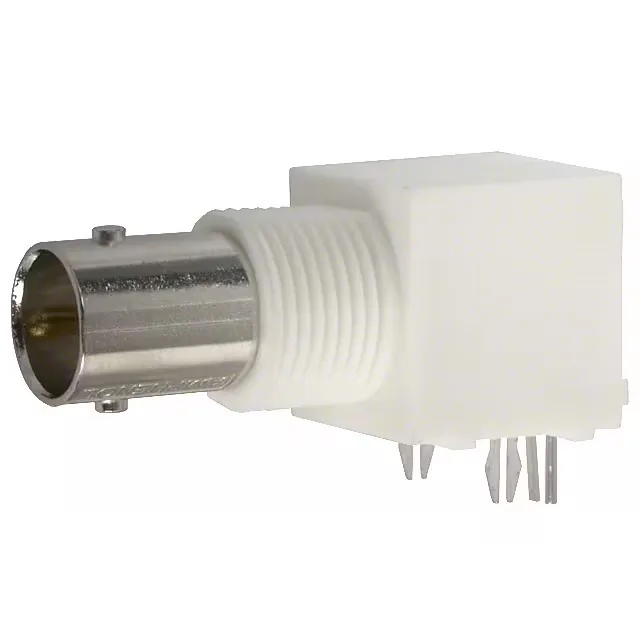
The 31-71047-1010: Rated to 1 GHz with 0.2 dB insertion loss, it handles the full bandwidth of a 3G-SDI link without rolling off the high-frequency edge. The 500 V voltage rating gives headroom for powered inline amplifiers or remote gear where the coax carries DC bias. This is a panel-mount right-angle through-hole part, bulkhead front-side nut, so it bolts through a chassis wall and the PCB sits parallel to the panel. The board lock holds it during wave solder, and the isolated body — zinc die cast with nickel finish — keeps the shell from shorting to the chassis ground if the design calls for a floating shield.
Why 75 Ohm Matters — Not a 50 Ohm Drop-In
The 31-71047-1010 is 75 Ohm, not the more common 50 Ohm BNC. The immediate peers — 31-5431, 31-5640-1010, and 031-5538-10RFX — are all 50 Ohm. The physical interface is the same bayonet lock, same 500 mating cycles, same 0.2 dB insertion loss, same 500 V rating. The difference is the centre contact geometry: a 75 Ohm BNC has a smaller centre pin and larger dielectric gap. A 50 Ohm plug will mate mechanically but the impedance mismatch creates a reflection at the junction — fine for DC or low-frequency, but above a few MHz the return loss degrades. For a 75 Ohm video path, stick with 75 Ohm cable and connectors end to end.