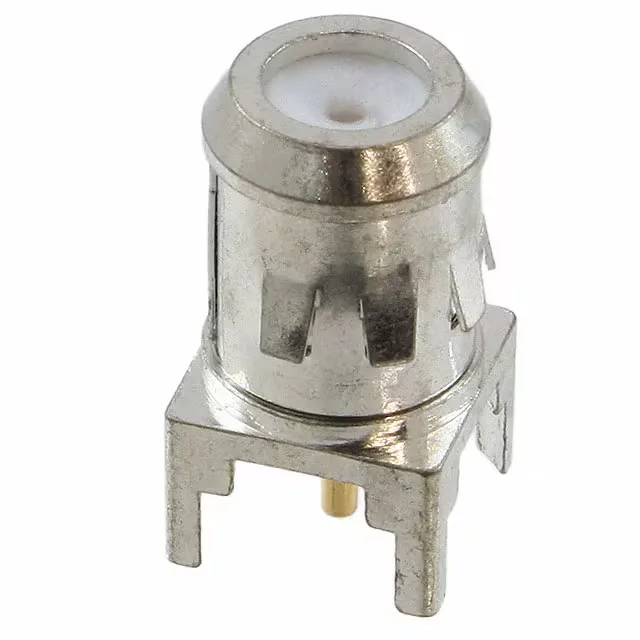
The brass body with a tin finish keeps the cost down for indoor, controlled-environment installations, while the snap-on fastening type gives a quick, positive mate without the torque of a threaded coupling. The through-hole mounting with solder termination is straightforward for a standard PCB or panel-mount layout, and the PTFE dielectric provides stable electrical performance across the rated -40°C to 60°C operating range.
A 50 Ohm connector in a 75 Ohm line creates a mismatch that reflects signal energy, degrading the picture or data at the far end. The 1 GHz maximum frequency is adequate for standard-definition and most high-definition analog video (which runs below 1 GHz), but it is not a candidate for modern multi-gigabit digital video interfaces like 3G-SDI or 12G-SDI, which push into the 3-12 GHz range. Compared to the Amphenol 252151-75 MCX jack (which also runs 75 Ohm but reaches 6 GHz), the 531-40051 trades bandwidth for a different mechanical interface — the G-type form factor is larger and more robust than the subminiature MCX, making it easier to handle in field installations where the connector sees occasional reconnection.
Mating Cycles and Body Finish — What the 100-Cycle Rating Means for Deployment
The 100 mating cycles rating reflects the tin body finish and the snap-on coupling mechanism. Tin-on-brass is a cost-effective plating choice, but it wears faster than gold-on-brass under repeated connect/disconnect cycles — the tin surface oxidizes and the snap-on detent loses retention force over time. For a connector that is mated once during equipment assembly and rarely touched again, 100 cycles is more than adequate. For a test-point or a frequently serviced panel connection, the 500-cycle gold-plated MCX or MMCX alternatives (such as the 252151-75 or 908-22100) would be a better fit.