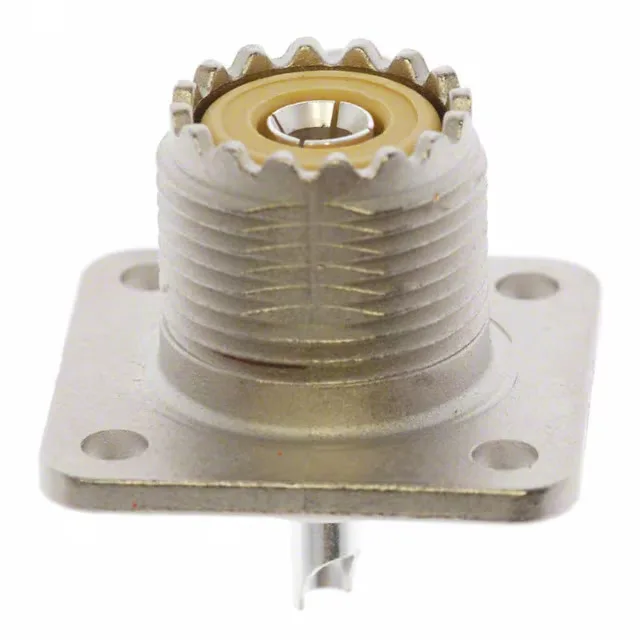
UHF Panel-Mount Receptacle for Antenna and Feedline Applications
The 83-1R: It is the fixed-side half of a UHF connector pair, typically used at antenna bases, transmitter output panels, or test equipment bulkheads. The connector carries a 500 V rating and is specified to 300 MHz maximum frequency, which covers the HF and low-VHF bands common in two-way radio, broadcast, and instrumentation feeds. The dielectric is polybutylene terephthalate (PBT) polyester, a stable insulator for the voltage and frequency range.
Mounting is through a panel flange with the connector body on the outside and the solder cup terminals accessible from the rear. This is a field-serviceable termination, not a crimp, so it suits one-off repairs or low-volume builds where a crimp die set is not justified.
The 83-1R mates with any standard UHF plug having a threaded coupling nut and a male pin. The closest listed peer is the Amphenol 083-8SP-1006, a UHF plug with a crimp shield and crimp center contact for RG-8, RG-213, and similar cables. That plug has the same 500 V rating and 300 MHz ceiling, the same nickel body finish, and the same silver-plated brass center contact — the difference is termination style (crimp vs solder cup) and gender. For a full assembly, the 083-8SP-1006 is the natural mating half. The 83-1R is not impedance-controlled to a constant value — the UHF series is a non-constant impedance design, so it is not specified for 50-ohm or 75-ohm systems. For applications requiring a controlled impedance, a BNC or N-type connector would be the correct choice.