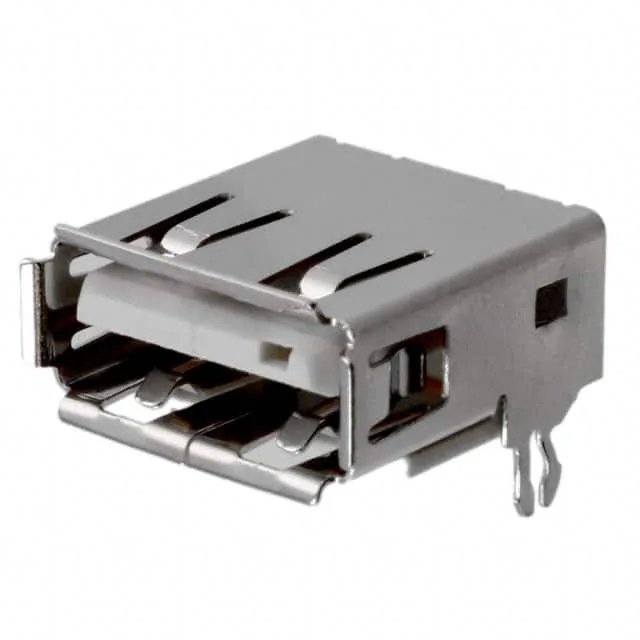
USB-A Receptacle for SMD Assembly — 87583-2010RLF
It conforms to USB 2.0 specifications, which means the signal pair is routed for 480 Mbps differential data while the power and ground contacts carry the VBUS and return path. The white insulation color is standard for USB 2.0 receptacles, aiding visual identification on the assembly line. The contact finish is gold with Amphenol's GXT™ plating, a hardened gold alloy that extends wear life beyond the 1500 mating cycles this part is rated for. The UL94 V-0 rated housing means the connector will not sustain a flame if the equipment sees an internal fault — a requirement for any board-mounted interconnect inside equipment that must pass a flammability test. The receptacle is unshielded, so it relies on the system-level enclosure or a separate grounding scheme for EMI containment rather than a metal shell.
Board Layout Considerations for the SMD Right-Angle Footprint
The right-angle surface-mount orientation places the USB port parallel to the PCB, which saves vertical clearance inside the enclosure — a common constraint in 1U rack-mount gear, set-top boxes, and thin-panel displays. The board lock consists of two through-hole solder tabs (one on each side of the connector body) that align with plated holes on the PCB. These tabs take the mechanical strain during cable insertion and withdrawal, so the SMD signal pins see only electrical connection duty. The recommended footprint is a hybrid: SMD pads for the four contacts plus plated through-holes for the board lock anchors. Without the board lock anchored, the right-angle lever arm from a USB cable inserted at the edge of the board would fatigue the SMD joints over time.
Mating Compatibility and USB 2.0 Signal Integrity
The pinout is standard: VBUS on pins 1 and 4 (the outer contacts), D− and D+ on pins 2 and 3 (the inner contacts). The 1500-cycle durability rating means the receptacle will maintain contact normal force and wipe distance across that many mate/unmate cycles without signal degradation — relevant for equipment that sees daily cable swaps over a multi-year service life. The GXT™ plating resists fretting corrosion that would otherwise increase contact resistance in high-vibration environments. This is a USB 2.0 connector, not USB 3.x. The 4-contact layout lacks the SuperSpeed differential pair and ground pins required for USB 3.0/3.1 Gen 1 operation. If the application requires 5 Gbps or faster data rates, a 9-position USB 3.x receptacle is needed. The 87583-2010RLF will physically accept a USB 3.x plug (the shell is the same), but the data rate will fall back to USB 2.0 because the extra contacts are not present.