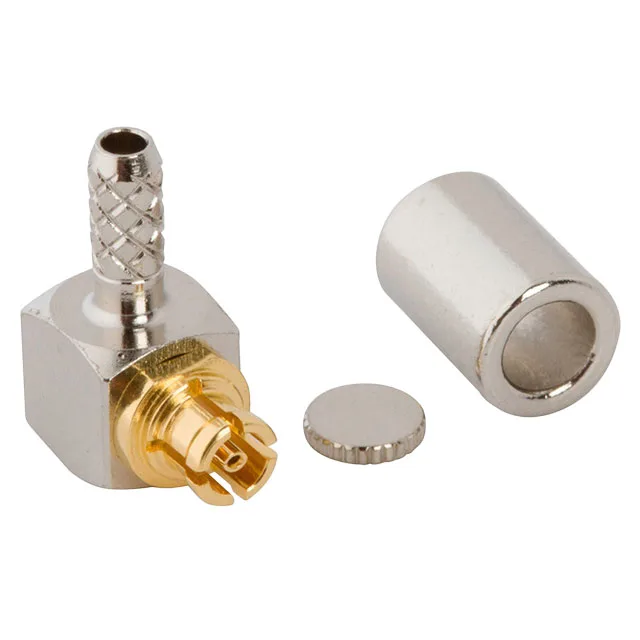
The 925-128C-51A: It terminates RG-178 and RG-196 cables — the two most common miniature coax sizes for this interface — and comes as a kit that includes the connector body and an end cap.
The 6 GHz ceiling covers L-band through C-band; for higher-frequency work (up to 40 GHz) you would step to the 925-138J-51P sibling, which is a male pin jack with a full detent. The cable group (RG-178, 196) tells you the coax diameter and dielectric fit — these are 0.070-inch and 0.080-inch cables respectively, so the crimp shield termination and solder centre contact are sized for those dimensions. 500 mating cycles is typical for gold-plated SMPM interfaces; the gold on both centre contact and body finish keeps contact resistance stable over repeated connect-disconnect cycles in test or field-service scenarios.
The 925-138J-51P is the male pin jack counterpart in the same SMPM family. Both are 50 Ohm, both use snap-on fastening, and both have 500 mating cycles. The key difference: the 925-128C-51A is a plug with a female socket and uses a crimp shield termination, while the 925-138J-51P is a jack with a male pin and uses a solder shield termination. If your cable assembly calls for a male pin on the mating end, the 925-138J-51P is the direct swap; if you need a female socket, this is your part. The 6 GHz frequency limit is identical on both.