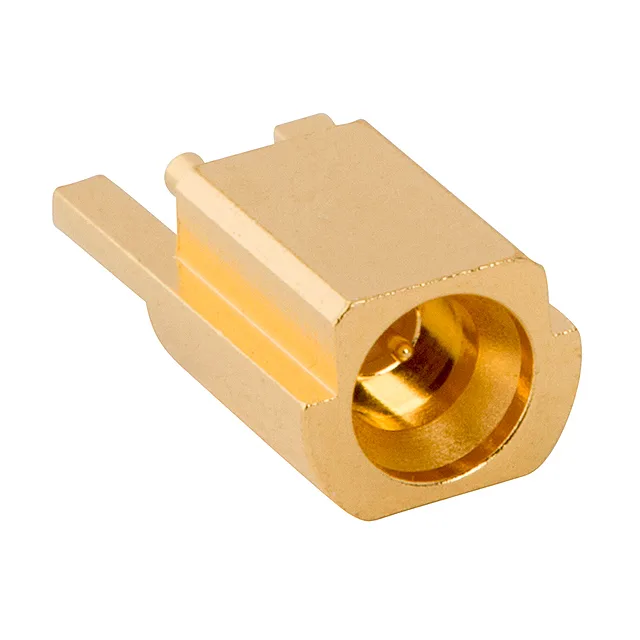
40 GHz SMPM Jack for Board-Edge RF Launch
The 925-169J-51PT: It's a single-port, smooth-bore design — no detent on the outer shell, so the retention comes from the mating socket's inner spring fingers. That gives a more consistent mating force across the 100-cycle rated life compared to a full-detent version, and it's the interface you want when the mating half is on a cable assembly that gets swapped a few times but not daily.
Board-Edge SMT Mount — Cutout Required
This jack mounts at the board edge in a cutout, with the shield and signal pads soldered to surface-mount lands. It's not a standard through-hole or SMT footprint — the PCB needs a rectangular cutout sized for the connector body, and the SMT pads sit on the board surface around the cutout. The Tape & Reel packaging suits automated placement for production runs; Cut Tape works for prototype or low-volume builds.
Smooth Bore vs Full Detent — What It Changes
The 925-169J-51PT uses a smooth bore outer contact, while the sibling 925-138J-51P uses a full detent. Smooth bore means the retention force is determined entirely by the mating socket's inner spring fingers — it's lower and more repeatable across 100 cycles. Full detent adds a mechanical catch on the plug that clicks into a groove in the jack, giving higher retention but a more pronounced insertion/extraction force profile. For a board-edge launch that sees a few cable swaps during test or integration, smooth bore is the cleaner choice.