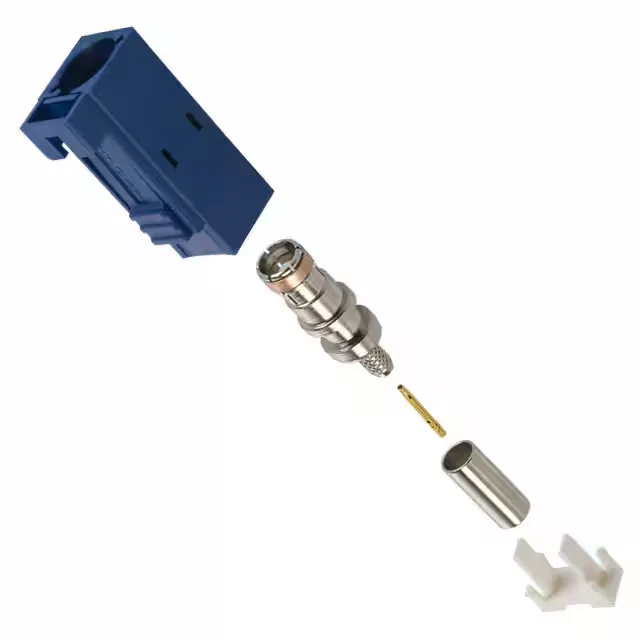
SMB Fakra Jack for 50 Ohm Systems — Code C Keying, Crimp Termination
The Amphenol FA1-NCSJ-C01-0 is a Code C-keyed SMB/Fakra jack (female socket) rated for 50 Ohm systems from DC to 6 GHz, with a specified insertion loss of 0.3 dB. It is the female in-line crimp member of the FA1 series, designed for coaxial cable termination in automotive-grade RF links — think GPS antennas, satellite radio, cellular telematics, or any Fakra-standard interconnect in a vehicle or outdoor enclosure. The Code C keying (blue housing, signal position) prevents cross-mating with other Fakra key codes in a multi-connector harness. This is a complete assembly kit — the package includes the jack body, one contact, one ferrule, one housing, and one locking clip. You do not need to source the crimp contact or ferrule separately; everything for one cable termination is in the bag.
Cable Fit and Termination — Crimp, No Soldering
The listed compatible cable groups are RG-174, RG-188A, RG-316, LMR-100, and M17/119-RG174. These are all 50 Ohm coax cables. The shield termination is a standard crimp ferrule over the braid.
Mechanical Fit — Free-Hanging, Latch Lock, 100 Cycles
Mounting type is free-hanging (in-line), so this jack is intended for cable-to-device or cable-to-cable connections where the connector body is not panel-mounted. The latch lock fastening provides positive retention against vibration — push to mate, pull the latch to release. The nickel-plated brass body gives adequate RF shielding and corrosion resistance for the intended environment.
Code C vs Code Z — The Keying Difference
The direct same-series alternative is the FA1-NZSJ-C01-0, which is identical in every spec — 50 Ohm, 6 GHz, 0.3 dB loss, same cable groups, same crimp termination, same 100-cycle life — except the keying code. The FA1-NCSJ-C01-0 uses Code C (blue housing, signal position), while the FA1-NZSJ-C01-0 uses Code Z (blue housing, water position). The only decision between them is which Fakra keying your mating receptacle requires. If your harness already has a Code C receptacle, this is the jack you need; if it is Code Z, go with the NZSJ variant. No other functional difference exists.