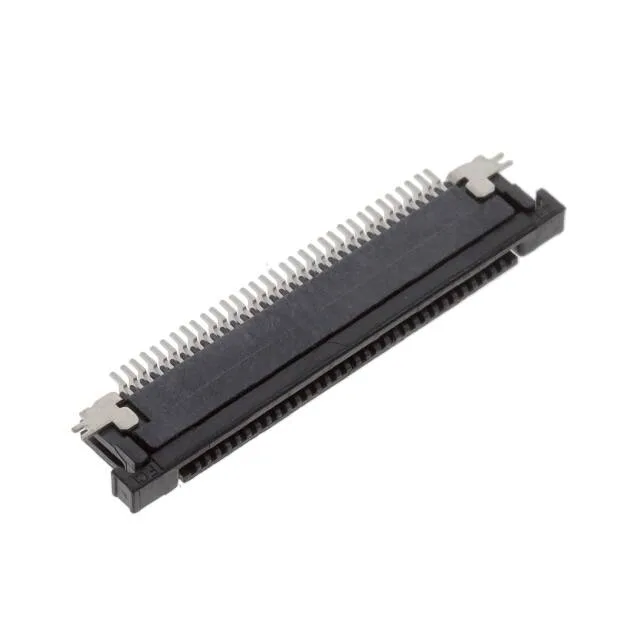
The connector is a top-contact ZIF (Zero Insertion Force) type with a slide lock. The ZIF mechanism means the FPC slides in without force — the lock then clamps the contacts down, avoiding pad damage during assembly. The slide lock gives positive retention against vibration, though the 20 mating cycle limit means this is a set-and-forget part, not a frequent disconnect point.
RoHS compliance is confirmed, so the part is suitable for EU and global markets that restrict lead and other substances.
Mating and Cable Fit
The top-contact configuration means the conductive traces on the FPC must face upward when inserted — get the cable orientation right or the circuit won't connect. Tin contact finish is rated for 20 mating cycles. In a product that is assembled once and never opened, that is fine. If the connector will see repeated disconnect in field service, the tin plating will wear and contact resistance will rise — a gold-plated sibling in the SFV-R series would be a better choice for high-cycle duty.
Position-Only Difference vs SFV32R and SFV35R
The SFV33R-2STE9HLF is identical in every spec — pitch, height, current, voltage, plating, locking, material, temperature range — to the 32-position SFV32R-2STE9HLF and the 35-position SFV35R-2STE9HLF. If the BOM calls for 33 positions, the 32-position part leaves one signal floating and the 35-position part leaves two contacts unused — neither is a drop-in substitute without a board spin. The 30-position SFV30R-2STE9HLF shares the same footprint and specs but with 30 circuits. For a 33-position design, the 30-position part is three contacts short — not a functional replacement.