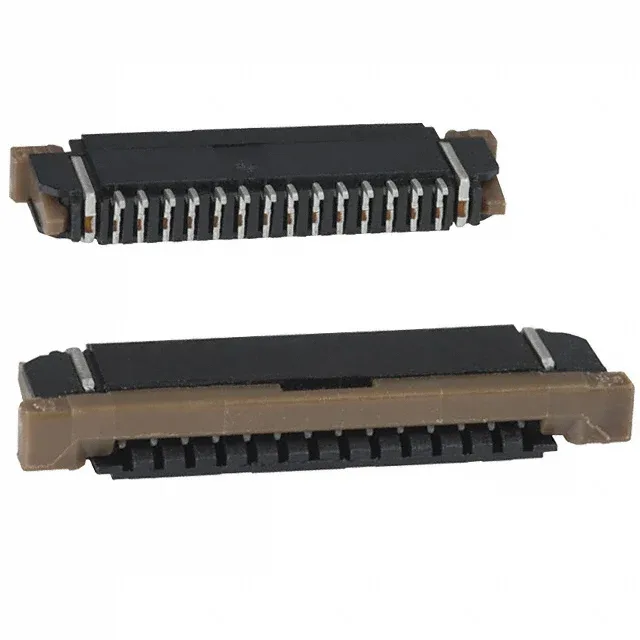
14-Position ZIF FFC/FPC Connector for Signal-Duty Board-to-Flex Interconnects
The SFW14R-3STE1LF: It uses a zero-insertion-force (ZIF) slide-lock actuator to secure the flex cable without stressing the contacts during insertion — a feature that matters when the cable is mated and unmated repeatedly in test or calibration fixtures. The right-angle SMT orientation keeps the mated FFC parallel to the board surface, saving z-height in tight enclosures — the 2.70 mm height above board leaves room for a low-profile cover or adjacent components.
Pitch, Position Count, and Contact Layout — BOM Fit Check
At 0.039" (1.00 mm) pitch and 14 circuits, this connector occupies a board footprint roughly 14 mm wide. The bottom-contact configuration means the FPC's conductive pads face downward against the SMT pads — confirm your flex cable's pad orientation matches before committing the layout. Compared to the 10-position sibling SFW10R-3STE1LF, this part adds four circuits in the same 1.00 mm pitch and 2.70 mm height envelope — the only dimensional difference is the longer body. If your BOM calls for 14 positions, the 10-position part won't fit the mating cable or the board footprint.
Active Production — Sourcing and Lifecycle Status
Mating Cycles and Contact Finish — Field-Service Implications
Rated for 20 mating cycles minimum with tin-plated contacts. Tin is adequate for low-cycle applications — a flex cable that is mated once during assembly and rarely touched again. For applications requiring frequent reconnection (test points, field-replaceable modules), a gold-plated contact variant in the SFW-R series would extend service life. The slide-lock actuator provides positive retention once the FFC is inserted — the lock prevents the cable from backing out under vibration, though the 20-cycle limit means the lock itself is not designed for repeated actuation over the product's life.