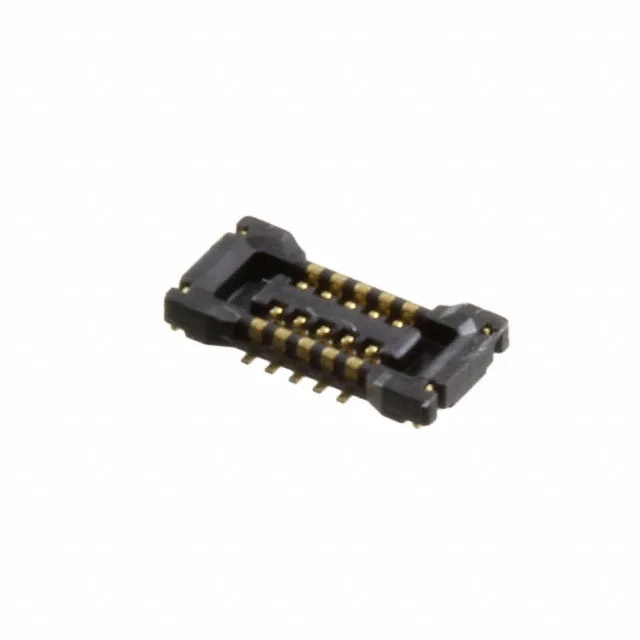
0.6mm Mated Stack — Tightest Fit in the BM20 Line
The Hirose BM20B(0.6)-10DS-0.4V(53) is a 10-position receptacle with center strip contacts, part of the BM20 series designed for ultra-low-profile board-to-board mezzanine stacking. Its defining dimension is the 0.6mm mated stacking height — the shortest in the BM20 family — which makes it the go-to choice when the Z-axis budget between parallel PCBs is under a millimeter. Gold-plated contacts with 2.00µin (0.051µm) thickness handle repeated mating cycles in field-serviceable assemblies.
Solder Retention Keeps It Put Through Reflow
This receptacle includes solder retention features — integral metal tabs on the body that reflow-solder to pads on the PCB. In a 0.6mm stack height design, there's no room for through-hole board locks, so these surface-mount retention anchors take the shear load from cable strain or vibration during the product's life. The 2-row, 10-contact layout gives a balanced footprint that resists tombstoning during reflow.
Mates with BM20 Series Headers — Same Pitch, Same Series
The BM20B(0.6)-10DS-0.4V(53) mates with the matching BM20 series header that shares the same 0.016" (0.40mm) pitch and 2-row layout. The "(0.6)" in the order code specifies the header's mated stacking height — so this receptacle pairs with a 0.6mm-tall header to achieve the total 0.6mm stack. A 0.8mm header (like the BM20B(0.8)-10DS-0.4V(51)) will not mate to the same height; the header height must match the receptacle's designated stack. The center strip contact interface is designed for signal-level currents typical of mezzanine interconnects in portable electronics.
Position Count vs. Sibling — 10 or 20 Positions at the Same Height
For the same 0.6mm mated stacking height, the BM20 series offers a 20-position variant — the BM20B(0.6)-20DS-0.4V(53). Both share the 0.016" (0.40mm) pitch, 2-row layout, gold contacts, and solder retention. The choice comes down to signal count: 10 positions for a narrower interconnect, 20 for denser routing. The 10-position body is physically shorter along the mating axis, which can simplify alignment in tight board stacks.