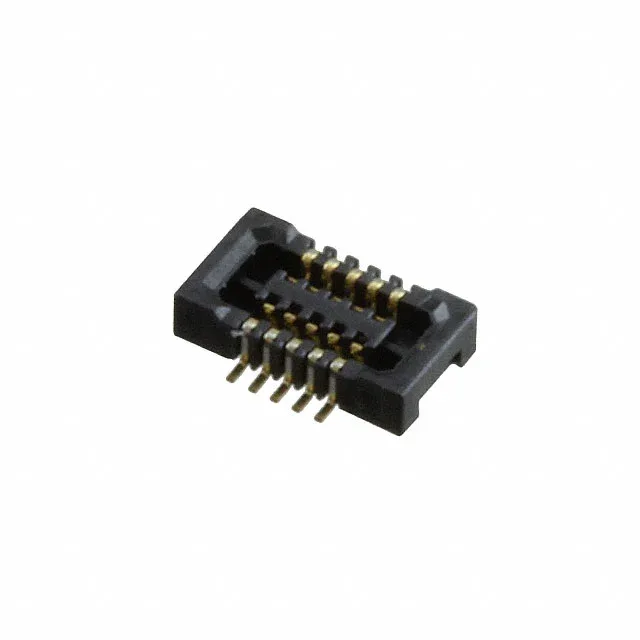
0.40 mm Pitch, 0.98 mm Stack — Mezzanine Connector for Tight Board Spacing
The Hirose DF37NB-10DS-0.4V(51) is a 10-position receptacle with center strip contacts from the DF37 series, designed for board-to-board mezzanine stacking. It uses a 0.016" (0.40 mm) pitch and dual-row layout, with a mated stacking height of 0.98 mm and a height above board of 0.038" (0.97 mm). The connector is surface-mount with solder retention features, and the contacts are gold-plated with a 2.00 µin (0.051 µm) thickness. Typical applications include compact handheld devices, wearables, and other portable electronics where board real estate and z-height are at a premium.
0.98 mm Mated Stack — What It Means for Board Layout
The 0.98 mm mated stacking height sets the gap between parallel PCBs in a mezzanine configuration. That is tight — barely over a millimeter — so the mating header must have an equally low profile. The 0.97 mm height above board on the receptacle side tells you the component sits flush against the PCB after reflow, with the solder retention pads anchoring it against shear forces during mating and vibration. For a layout engineer, that 0.40 mm pitch means fine traces and tight escape routing between pads — expect micro-vias or via-in-pad if you are running more than a couple of signals per row.
10 Positions vs 16 and 20 — Picking the Right Circuit Count
This 10-position part sits alongside the 16-position DF37NB-16DS-0.4V(51) and the 20-position DF37NB-20DS-0.4V(51) in the same DF37 series. If your BOM calls for 10 signals, this is the one. The 16- and 20-position siblings are direct drop-in alternatives for higher-density boards, but they require the same board footprint width — the extra positions add length, not width.
Gold Plating Thickness — 2.00 µin vs 4.00 µin Variant
The (51) suffix on this order code specifies 2.00 µin (0.051 µm) gold contact finish thickness. The sibling DF37NB-10DS-0.4V(75) carries 4.00 µin (0.100 µm) gold. For a mezzanine connector that sees repeated mating cycles — say, during board-level testing or field-service reconnects — the thicker gold on the (75) variant buys you more mating cycles before wear-through. If this is a one-time mate inside a sealed device, the 2.00 µin gold is adequate and saves cost. Both are active and RoHS compliant.