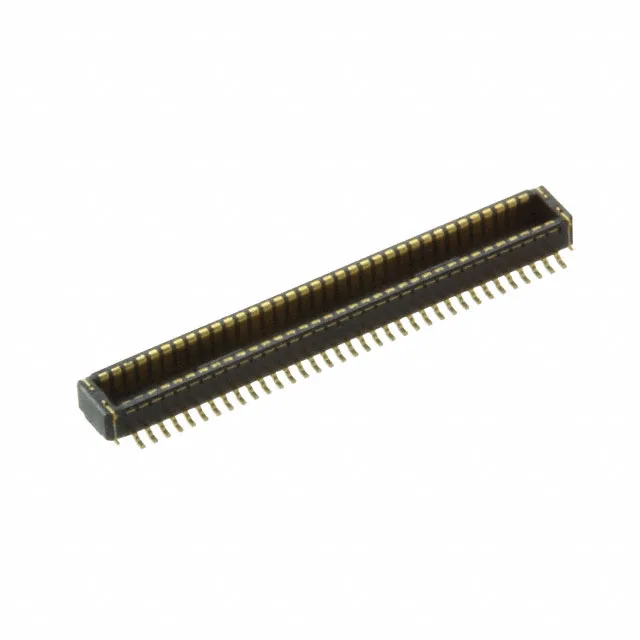
70-Position Shielded Plug for Tight Mezzanine Stacking
The Hirose DF40GB-70DP-0.4V(58) is a 70-position plug with outer shroud contacts from the DF40 series, designed for board-to-board mezzanine connections where board spacing is tight. The 0.016" (0.40mm) pitch and dual-row layout pack 70 signal lines into a compact footprint, while the shielded construction with solder retention tabs keeps the interface grounded and mechanically stable during reflow. Mated stacking heights of 1.5mm or 3mm are supported, making this plug suitable for handheld devices, camera modules, or any dense PCB stack where z-height is at a premium.
The 0.045" (1.14mm) height above board means the plug sits low on the PCB, leaving room for the mating receptacle and components on the opposite board. The two supported mated stacking heights — 1.5mm and 3mm — are set by the receptacle variant chosen, not by the plug itself. For a 1.5mm total stack, the receptacle must be the shorter version; for 3mm, the taller receptacle. The 0.40mm pitch demands careful trace routing — fine-line PCB capability is expected for fanout.
Shielding and Solder Retention
The shielded outer shroud contacts provide continuous ground reference around the signal pins, reducing EMI radiated from the interconnect. Solder retention tabs on the SMT feet anchor the plug to the board during reflow and add shear strength against cable or board flex after assembly. This combination suits applications where signal integrity matters — display interfaces, camera modules, or high-speed data links within a sealed chassis.
Position Count vs. Siblings
Within the same DF40GB-0.4V(58) sub-family, the 70-position plug is the highest-density option. The DF40GB-48DP-0.4V(58) carries 48 positions and the DF40GB-30DP-0.4V(58) carries 30 positions, all sharing the same 0.40mm pitch, gold plating, shielded construction, and 0.045" (1.14mm) height. The choice comes down to the signal count on the BOM — 70 positions for a wide parallel bus or multi-channel sensor array, 48 or 30 for narrower interfaces. No other functional difference exists between these three variants.