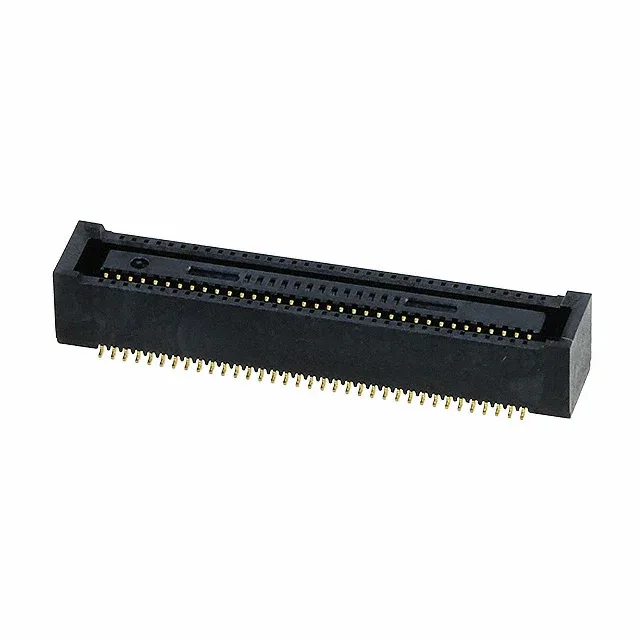
0.40 mm Pitch Mezzanine Receptacle for Tight Board Spacing
The Hirose DF40HC(3.0)-70DS-0.4V(58) is a 70-position receptacle from the DF40 series, designed for board-to-board mezzanine stacking. It uses a 0.016" (0.40mm) pitch in a dual-row layout, with center strip contacts that mate to the matching DF40 header. The connector sits 0.114" (2.90mm) above the board surface and achieves a 3mm mated stack height — the total gap between the two PCBs when the header and receptacle are fully mated. Gold contact finish is standard across the series, suited for the repeated mating cycles common in modular electronics.
70 Positions, Dual-Row — Routing Density at 0.40 mm Pitch
At 70 positions across two rows, each row carries 35 contacts on a 0.40 mm pitch. That density demands careful via escape on the board — trace widths and spacing need to match the fine pitch for signal integrity in high-speed designs. Compared to the 80-position DF40HC(3.0)-80DS-0.4V(58) or the 100-position DF40HC(3.0)-100DS-0.4V(58), this 70-position variant fits BOMs that need exactly 70 signal lines without wasting board area on unused contacts.
Active Production, ROHS3 — No LTB Risk
For BOM planning, this part is a current-production line item — no need to stockpile or qualify a substitute. The (58) suffix indicates a specific plating and packaging variant; the DF40HC(3.0)-70DS-0.4V(51) shares the same dimensions and pitch but specifies 2.00µin (0.051µm) gold contact finish thickness, which may matter for applications requiring a documented plating grade for mating cycle life.
Mating and Termination — Surface Mount, Header Required
This is a surface-mount receptacle — no through-hole posts, no solder tails. It mates with the corresponding DF40 series header (the male half of the mezzanine pair). The 3 mm stacking height is achieved when the header and receptacle are mated; the header's own height above board plus the receptacle's 0.114" (2.90mm) equals the total 3mm gap. The center strip contact arrangement means the mating interface is a row of flat contacts, not individual pins — alignment is guided by the header's boss features.