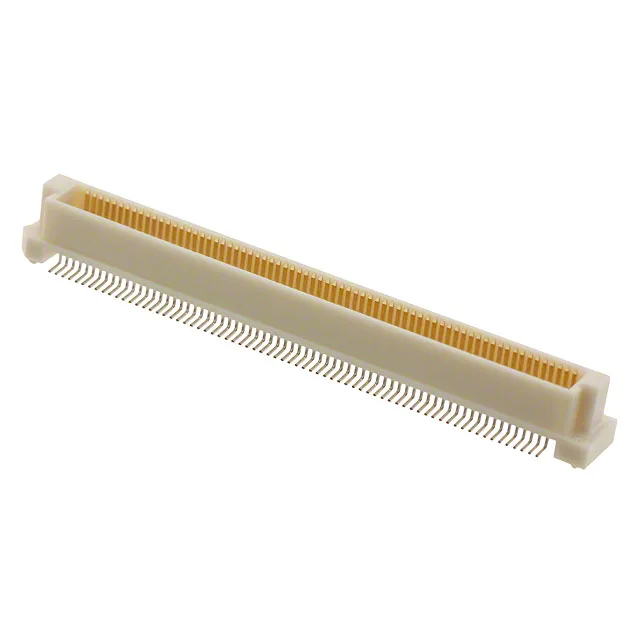
At a 0.024" (0.60 mm) pitch, it packs 70 contacts per row into a compact SMT footprint — the tight pitch is the main constraint on board routing density and per-circuit current, not the contact itself. Outer shroud contacts surround the signal array to provide a ground reference and mechanical alignment, while the integrated board guide takes the shear load during mating so the signal pins don't absorb the misalignment. Typical use is inside telecom switches, servers, or industrial controllers where a high-signal-count mezzanine card needs to stack at a fixed board-to-board gap.
Stack Height Selection — One Header, Two Gaps
The FX8C-140P-SV(91) supports mated stacking heights of 5 mm and 10 mm. The header itself is a fixed 4.45 mm above the board; the stack height is determined by which mating receptacle is used. That means one BOM line for the header covers two board-spacing requirements — useful if the same baseboard design mates with two different daughtercards at different gaps. The same-position siblings FX8C-140P-SV1(91) (5.45 mm board height), FX8C-140P-SV2(91) (6.45 mm), and FX8C-140P-SV4(91) (8.45 mm) share the identical 140-position, 0.60 mm pitch, gold-plated layout and outer shroud contacts. The only variable is the header's own height above the PCB, which shifts the mated stack by the same delta. If the design already calls for a 5 mm or 10 mm gap, the SV(91) is the correct call; if a non-standard gap is needed, one of the SV1/SV2/SV4 variants covers it without changing the footprint or pinout.
No single-vendor lock — the FunctionMax FX8C series is a standard Hirose mezzanine family, so the footprint and mating half are consistent across the series if a different stack height is needed later.