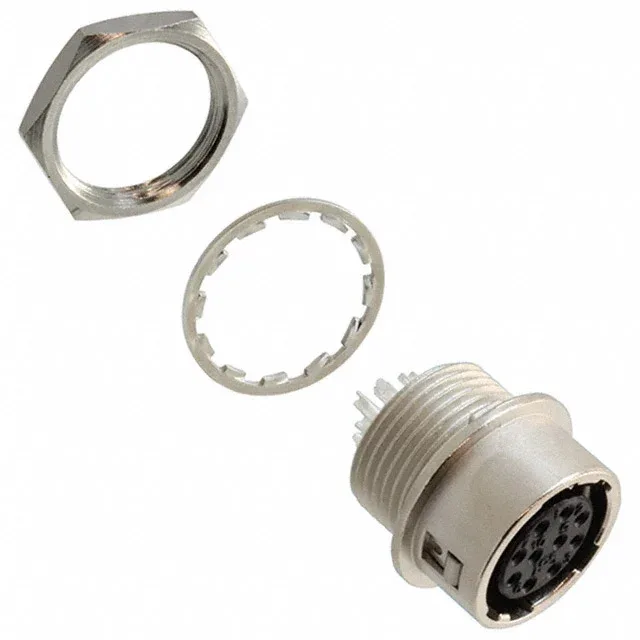
The Hirose HR10A-10R-10S(71) is a 10-position panel-mount receptacle from the HR10A series, designed for push-pull coupling in applications that require quick, secure mating without a threaded lock ring. It carries female sockets terminated via solder cup — a field-termination method that suits service loops and harness repairs where crimp tooling isn't available. The 2 A per-contact rating and 100VAC / 140VDC voltage rating place it firmly in the signal-and-low-power range, not main bus distribution. The zinc alloy shell with nickel finish and a polyamide (nylon) insert rated UL94 V-0 make it suitable for industrial control panels, test equipment, and instrumentation enclosures where a metal-bodied circular connector with a positive push-pull latch is preferred over a bayonet or threaded coupling.
The dual voltage rating — 100VAC and 140VDC — reflects the creepage and clearance of the 10-shell-size insert; the DC rating is higher because AC peak-to-peak is the limiting factor.
This receptacle mounts through a panel bulkhead and is secured from the rear with a nut — the shell material is zinc alloy with nickel finish, providing a robust ground path through the panel. The solder cup termination accepts stripped wire directly; no crimp terminal is needed, but the joint must be strain-relieved off the connector body. The push-pull fastening mechanism locks with an audible click and releases by pulling the coupling ring — no tool required for mating or unmating. The keyed orientation prevents rotational misalignment during insertion.
How It Compares to Nearby Siblings
Against the HR10A-10R-12S(71), the difference is strictly position count: 10 positions vs 12 positions at the same shell size (10), same 2 A rating, same silver contact finish, same push-pull coupling. The 12-position version uses the same panel cutout and mating plug — the choice is simply whether the harness needs 10 or 12 circuits. Against the HR10A-10R-10SB(71), the difference is packaging and insert material: the 10SB ships in tray instead of bulk, and uses a PBT insert rather than polyamide — the electrical ratings are identical, so the choice is driven by line-feeding preference (tray for pick-and-place of the receptacle itself, though solder cup is hand-terminated) or material compatibility with the operating environment.