Last-Buy Status and Sourcing Reality
The Hirose JR21WR-16S(31) is officially on Last Buy status — the manufacturer has ended regular production, and remaining stock is being drawn down through distribution. This is not a part to design into a new BOM; it is a service-replacement or bridge-quantity buy for existing JR-W harnesses in the field.
What This Connector Is — JR-W Series, Shell Size 21
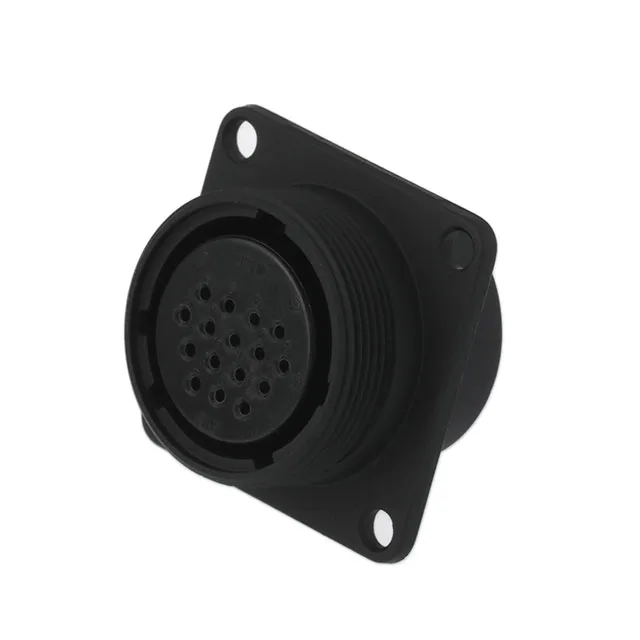
The JR21WR-16S(31) is a 16-position receptacle from the Hirose JR-W series, a rugged circular connector family designed for industrial, automotive, and telecommunications environments where a sealed, threaded-coupling interconnect is required. The shell size is 21, which is the mid-range body diameter in the JR-W lineup — large enough for 16 contacts at 5 A each, but compact enough for panel-mount installations where space is constrained. The connector uses a panel-mount flange with a threaded coupling ring for mating, and the orientation is keyed to prevent incorrect insertion in multi-connector panels.
Sealing and Environmental Rating — IP67/IP68
The JR21WR-16S(31) carries an IP67/IP68 ingress protection rating — dust-tight and waterproof when mated with the corresponding JR-W plug. IP67 covers temporary immersion to 1 m for 30 minutes; IP68 extends that to deeper, longer submersion per manufacturer specification. This makes the connector suited for outdoor telecom cabinets, washdown food-processing equipment, vehicle underbody harnesses, and marine electronics where moisture ingress would otherwise kill a standard circular connector.
Contact System — Silver Plating, Solder Cup Termination
The termination is solder cup, and the current rating is 5 A per contact.
Mating and Panel Installation
The threaded coupling ring on the plug engages with the receptacle's threaded shell — tighten by hand or with a spanner wrench for vibration-resistant mating. The keyed orientation ensures the plug can only be inserted one way, which is critical when multiple JR-W connectors are ganged on a panel. The panel mount uses a flange with mounting holes — the connector is bolted to the panel from the rear, and the mating plug engages from the front.