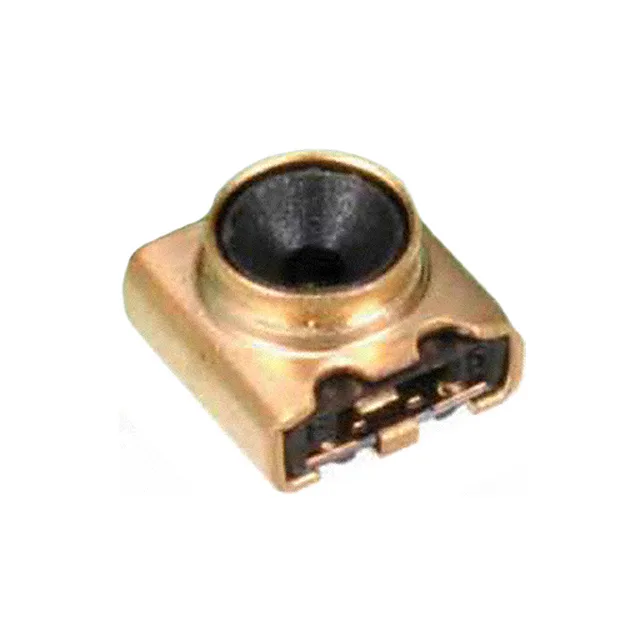
50 Ohm Coaxial Switch — 4 mm Plug Interface, 6 GHz Ceiling
The Hirose MS-156HF(01) is a 50 Ohm coaxial switch receptacle from the MS-156HF series, designed for surface-mount assembly. It mates with a 4 mm diameter coaxial plug via a snap-on fastening, and carries an internal switch that reroutes the signal path when the plug is inserted or removed — no external relay needed. Rated to 6 GHz with 0.15 dB insertion loss, it suits sub-6 GHz 5G, Wi-Fi 6E, and test port switching where the board footprint must stay compact.
What the 6 GHz and 0.15 dB Ratings Mean for the RF Path
The 6 GHz frequency ceiling covers the full 5G FR1 band (sub-7 GHz) and the 5.9–7.1 GHz unlicensed spectrum, so this connector passes the entire signal without a roll-off notch. The 0.15 dB insertion loss is the power lost through the switch contacts and internal path — at 6 GHz that is about 3.4% of the input power, which is low enough that a receiver sensitivity budget of -100 dBm still has margin.
Internal Switch — How It Changes the Signal Path
The internal switch is the key differentiator versus a plain coaxial receptacle. When no plug is inserted, the switch connects the centre contact to an internal termination or alternate path — typically to ground or a test load. Inserting the 4 mm plug actuates the switch, breaking that internal connection and routing the signal through the plug. This eliminates a separate RF relay or switch IC on the board, saving space and insertion loss. The switch contacts are gold-plated beryllium copper, rated for 100 mating cycles — enough for test-fixture or module-swap duty, but not a daily-disconnect production line.
Gold Body, SMT Termination — Assembly and Environment
Surface-mount termination suits reflow assembly; the strip packaging feeds into pick-and-place without a tape carrier.
How MS-156HF(01) Sits in the MS-156HF Series
The MS-156HF(01) shares the same 50 Ohm, 6 GHz, 0.15 dB insertion loss, and internal switch core as the base MS-156HF and the (20) and (22) suffix variants. The difference is packaging and optional features: MS-156HF ships in Tape & Reel, Cut Tape, and Digi-Reel; MS-156HF(01) ships in Strip only. MS-156HF(22) adds a Pick and Place Cap for automated handling. All four have the same electrical and mechanical interface — the choice is purely a BOM packaging call. No functional second-source exists outside the MS-156HF family.