What it is and where it fits
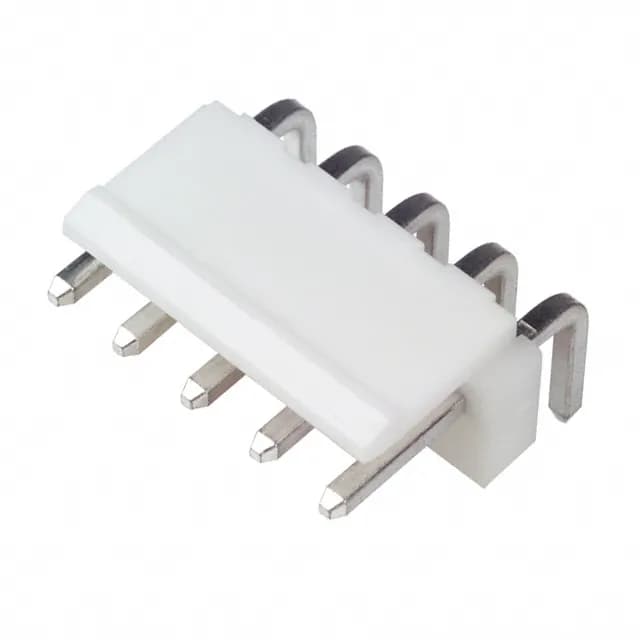
The B5PS-VH is the 5-circuit member of the VH series — a single-row, right-angle through-hole header with a 0.156 inch (3.96 mm) pitch and a locking ramp on the shroud that resists vibration-assisted unmating. Tin-plated brass contacts carry 10 A per circuit at up to 250 V, and the one-wall shroud guides the mating half into the correct orientation before the contacts engage. Board-to-cable headers at this pitch and current rating appear in power-supply boards, industrial control modules, and harness bulkheads where a discrete wire segment terminates to a PCB. The right-angle orientation saves vertical board space — the connector sits flat against the board surface and routes the cable parallel to the PCB plane. The 0.335 inch (8.51 mm) insulation height and 0.142 inch (3.60 mm) tail length define the PCB pad footprint and the hole diameter needed for through-hole solder. The square contact cross-section makes the header polarization unambiguous — it drops into the footprint one way and the locking ramp prevents reverse insertion of the mating housing.
What the ratings mean for the fit
The 10 A per circuit rating is governed by the tin plating on both the mating face and the solder tail. Tin contacts are adequate for the mating cycle counts typical of field-replaceable subassemblies but wear faster than gold-plated alternatives in high-cycle reconnect duty. If the application requires more than a few dozen mate/de-mate cycles, the tin finish is the limiting factor — not the current rating. The 250 V rating is a working voltage, not a dielectric withstanding test voltage. For a board that sees transients or high-energy mains-adjacent circuits, the margin between working voltage and breakdown is a board-level design question, not a connector-spec question — the B5PS-VH is rated for the signal and low-power circuit ranges typical of industrial control, not for AC mains switching. Operating temperature runs from -25°C to 85°C. Below -25°C the polyamide (PA66) housing loses impact toughness; above 85°C the nylon material softens and the contact normal force degrades. This range covers indoor industrial and instrumentation environments but excludes outdoor enclosures without thermal management or automotive under-hood zones.
B6PS-VH — the same form, one more circuit
The B6PS-VH is the 6-position variant of this exact right-angle through-hole shroud design. Same pitch (3.96 mm), same current (10 A), same voltage (250 V), same tin finish, same locking ramp, same mounting orientation — only the position count differs. If the BOM needs a 6-circuit header in this series, the B6PS-VH is the drop-in sibling; no redesign of the PCB footprint pattern is required beyond extending the drill and pad row by one position.
Lifecycle and sourcing posture
RoHS non-compliant is the compliance flag that matters. This is not a quality defect — the VH series predates the RoHS directive and the tin plating formulation has not been changed to remove restricted substances. New designs targeting European or Asian markets must flag this part as non-conforming and seek a RoHS-compliant alternative in the same pitch and current class, or accept a RoHS exemption documentation path. For sourcing: confirm the mating housing order code before committing — the locking ramp on the shroud locks into a compatible VH-series receptacle housing. The 5-position header does not cross-reference to a RoHS-compliant equivalent within this series on the available record; if compliance is required, the sourcing search needs to extend to the broader 3.96 mm pitch header market for a tin-finish or gold-finish variant with an RoHS declaration.