Current and voltage — signal-level duty only
The 1719710002: Rated 3A per contact at 250V, this header is built for low-power signal and control circuits — not for high-current power distribution.
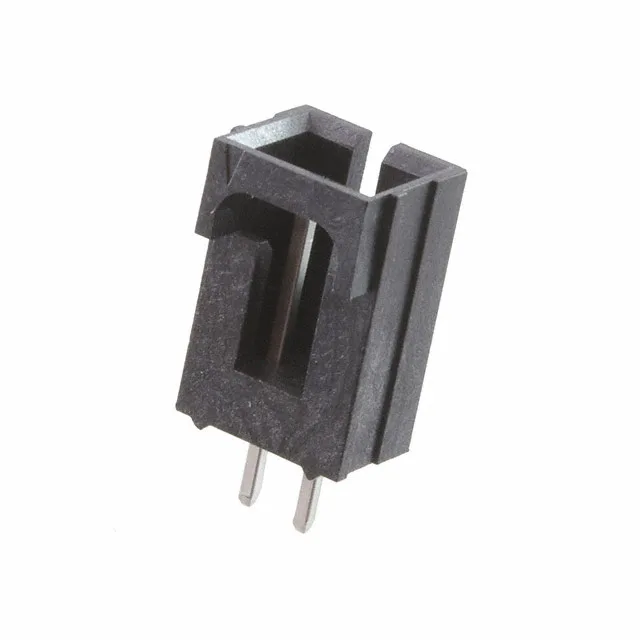
Molex SL 171971 series male pin header, 1719710002, 2 positions, 0.100" (2.54mm) pitch, shrouded-4 wall, through-hole solder, tin-plated contacts, polarizing key, latch holder, UL94 V-0 LCP housing, rated 3A at 250V, -40°C to 105°C.
| Parameter | Value |
|---|---|
| Series | SL 171971 |
| Type | Male Pin |
| Mounting | Through Hole |
| Connector type | Header |
| Fastening type | Latch Holder |
| Voltage rating | 250V |
| Current rating | 3A |
| Operating temperature | -40°C ~ 105°C |
| Contact material | Brass |
| Insulation color | Black |
| Insulation height | 0.465\" (11.80mm) |
| Insulation material | Liquid Crystal Polymer (LCP) |
| Parameter | Value |
|---|---|
| Material flammability rating | UL94 V-0 |
| Style | Board to Cable/Wire |
| Package | Tube |
| Features | Polarizing Key |
| Shrouding | Shrouded - 4 Wall |
| Termination | Solder |
| Applications | General Purpose |
| Contact shape | Circular |
| Rows | 1 |
| Pitch | 0.100\" (2.54mm) |
| Positions | 2 |
| Contact finish - post | Tin |
| Contact length - post | 0.130\" (3.30mm) |
| Contact finish - mating | Tin |
| Contact length - mating | 0.240\" (6.10mm) |
| Contact finish thickness - post | 100.0µin (2.54µm) |
| Contact finish thickness - mating | 100.0µin (2.54µm) |
The 1719710002: Rated 3A per contact at 250V, this header is built for low-power signal and control circuits — not for high-current power distribution.
Buyers need a reliable source to purchase the exact part for their BOM or project.
Sourcing buyers compare prices across distributors to optimize cost.
Immediate availability is critical to avoid production delays.
Design engineers need full specifications to validate fit and compliance.
Maintenance techs and engineers need the mating connector to ensure system compatibility.
Polarizing key ensures correct orientation during assembly, preventing misconnection.