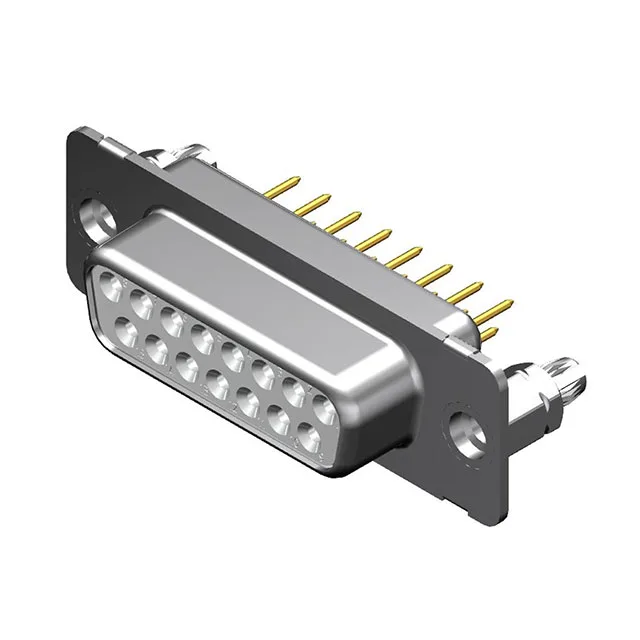
The Molex 1731091145 is a 9-position D-Sub receptacle from the F, FCT 173109 series, built in the standard DE-1E shell layout — the same footprint as a classic DB-9. The 9 positions and 2 rows match the DE-9 panel cutout and mate with any standard 9-position D-Sub plug. The shell is steel with tin plating, giving good EMI shielding when the mating connector's ground indents make contact. What sets this receptacle apart from many off-the-shelf D-subs is the unthreaded flange: the housing/shell has no threaded insert for jackscrews. That means the mating plug must carry its own jackscrews, or you need a separate locking mechanism, to hold the pair together under vibration. If your application sees shock or continuous movement, factor in a locking solution — the unthreaded flange alone won't keep the connection tight. The 5A per-contact rating, combined with machined copper-alloy contacts and gold-over-nickel plating, suits this receptacle for signal-level interconnects in control cabinets, test equipment, and industrial I/O panels. The 5A is a per-contact maximum at room temperature; in a fully loaded 9-position connector, the total current through the bundle should be derated based on ambient temperature and airflow.
Flange Feature and Shell Size — The Two Specs That Trip People Up
Two details on this part routinely cause ordering mistakes. First, the flange feature: it's listed as "Housing/Shell (Unthreaded)". That means the mounting holes in the flanges are plain — no threads. You can't screw a jackscrew into the receptacle side; the jackscrew must be on the mating plug, or you use a nut-and-bolt through the flange. Second, the shell size is "1 (DE, E)" — that's the standard 9-position D-sub shell, not the larger DA-15 or DB-25 shell. A DE-9 panel cutout is 0.984 inches by 0.395 inches (25.0 mm by 10.0 mm) with the mounting holes on 0.709-inch (18.0 mm) centers. If your panel is punched for a DB-25, this won't fit without an adapter bracket.