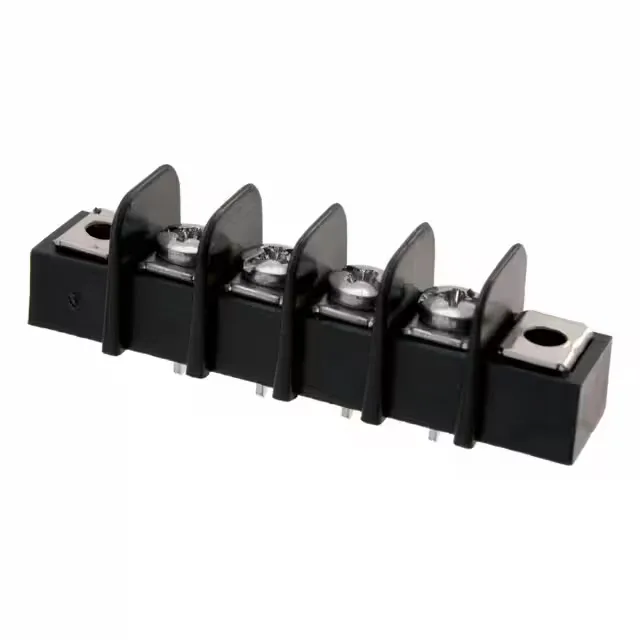
The Molex 387206204 is a 4-circuit barrier block from the Beau 38720 series, a terminal block type with dual-wall barrier construction. It carries a 0.375" (9.53 mm) pitch, rated 15 A at 300 V, and accepts 14-22 AWG wire. The top termination uses screws with a zinc clear chromate finish; the bottom terminates to a PC pin for through-hole PCB mounting, with additional chassis/panel mount capability via the flanged housing. The black PBT insulator is rated UL94 V-0.
The flanged housing also allows chassis or panel mounting, so the block can serve as a panel feed-through with the PC pin acting as a solder terminal on the board side. The dual-wall barrier design (2 Wall) provides physical isolation between adjacent circuits, reducing the risk of arcing or accidental bridging.
The 387206204 is the 4-circuit member of the Beau 38720 series. If the BOM calls for 5 circuits, the 387206205 is the same block with 5 positions at the same 0.375" (9.53 mm) pitch, same 15 A and 300 V ratings, same flanged housing and termination style. For 8 circuits, the 387206208; for 12 circuits, the 387206212. The mounting hole pattern and overall length scale with circuit count, so swapping between them requires checking the board layout or panel cutout.