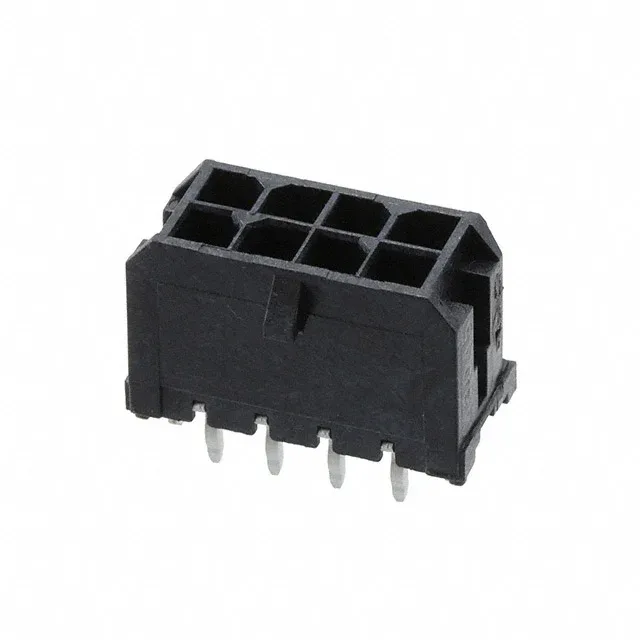
What the 430450826 is
The Molex 430450826 is the 8-circuit dual-row member of the Micro-Fit 3.0 43045 series — a board-to-cable power header designed for wire-to-board interconnects in harness assemblies. The header carries gold-plated mating contacts rated 8 A per circuit at up to 600 V, with tin-plated solder tails in a through-hole kinked-pin configuration. The LCP housing is UL94 V-0 rated, shrouded on four sides with board-guide ribs and a locking ramp that secures the mating receptacle. All eight positions are populated.
What the ratings mean for fit and duty
The 3.00 mm pitch and dual-row layout match the standard Micro-Fit 3.0 footprint — any 8-position Micro-Fit 3.0 receptacle housing with matching polarization will mate. The 8 A per-contact rating at 600 V is the headline spec, but the plating split is what governs where you can actually run this: gold on the mating face (30.0 µin / 0.76 µm) handles repeated engagement cycles and signal-quality contact resistance; tin on the solder post side (100.0 µin / 2.54 µm) is sized for solderability and long-term barrel integrity, not for current density at the termination. The kinked pin and through-hole mount give mechanical pull-out resistance that surface-mount alone cannot provide — a meaningful advantage in any harness that sees vibration or thermal cycling. Board-lock features prevent uplift during reflow and in-service flex.
Where it goes and what it faces
The 430450826 targets board-to-cable power interconnect in automotive, industrial, medical, and telecommunications equipment — applications where the 600 V rating and UL94 V-0 flammability class matter for safety and type-approval. The four-wall shroud and locking ramp keep the mated pair secured against vibration; the 0.390-inch insulation height gives the header enough standoff to clear conformal coat or under-board components. Square pin geometry accepts the matching crimp receptacle squarely and resists rotation under mating stress. The brass base material handles the 8 A current without the thermal run-away risk that thinner contact materials introduce at rated current.
