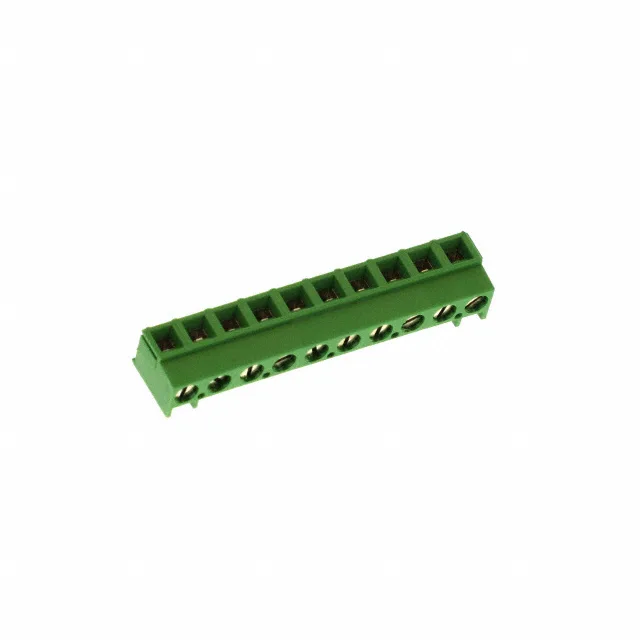
It uses a rising cage clamp termination — the screw tightens a clamp that pulls the wire against a current bar, giving a gas-tight connection on solid or stranded wire from 16-30 AWG. Rated 13.5 A at 300 V, it handles typical panel-level signal and low-power distribution without derating in a 25 °C ambient. The green housing is the Buchanan series colour code, and the side interlocking feature lets you snap multiple blocks together into a longer strip without losing alignment.
The 5.08 mm pitch gives you enough clearance between adjacent terminals for a standard screwdriver tip and a ring or spade lug without shorting across barriers. That spacing also supports the 300 V working voltage — at tighter pitches you start worrying about creepage in humid cabinets. The 13.5 A per position is a continuous rating; if your ambient inside the enclosure runs above 25 °C, you need to derate per the TE application note, but for most control panels this block carries a 10 A fused circuit without breaking a sweat. The M3 screw with a 0.68 Nm (6 Lb-In) torque spec is a familiar feel — snug it down until the rising cage bottoms on the wire, but don't over-crank it or you'll strip the brass threads.
Mounting and Ganging: Side Interlocking and Through-Hole Pins
This block mounts vertically with the board — the wire entry is from the top, and the solder pins go through the PCB. The side interlocking feature is what makes the Buchanan series practical for multi-circuit builds: you buy individual 10-position blocks and snap them together side-by-side to get 20, 30, or more positions on the same pitch. The interlock keeps the blocks aligned so the PCB footprint stays consistent across the whole strip. The housing is PA66 (Nylon 6/6), which holds up to typical soldering temperatures and resists creep under screw torque. The clamp and screw are both brass with nickel plating — corrosion-resistant in industrial atmospheres.