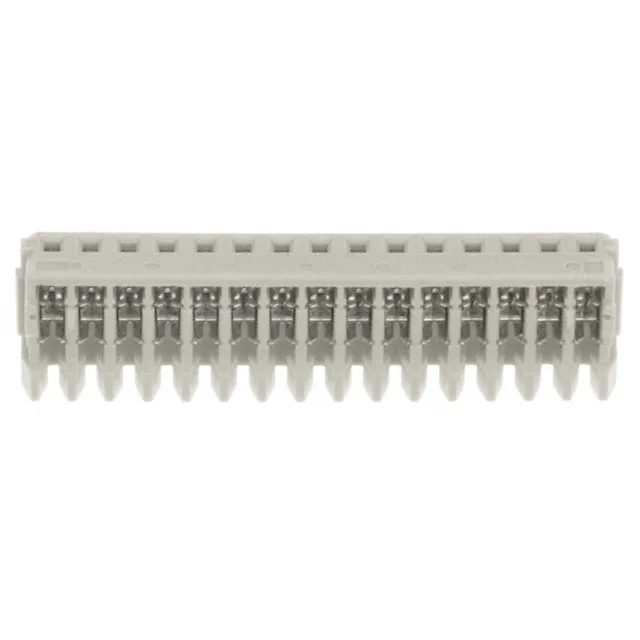
Mini CT IDC Receptacle for Discrete Wire
At a 0.059" (1.50mm) pitch, this is the fine-pitch end of the Mini CT family — the tight centerline keeps the board footprint small but demands precise wire alignment during termination. The closed-end housing prevents the contacts from stubbing against the back wall during insertion, giving a positive wire stop that helps the harness assembler feel the termination seat. Tin-plated female sockets keep per-unit cost low, though the trade-off is a lower mating-cycle budget than gold — this is a set-and-forget interconnect for internal harnesses, not a repeatedly disconnected field-service point.
IDC Termination on Discrete Wire — What That Means
Most IDC connectors terminate ribbon cable; the 1-353293-5 terminates discrete 26-28 AWG wire. The IDC slot pierces the insulation and grips the conductor without stripping or crimping — a clean, repeatable termination for high-volume harness builds. The gray housing is the standard colour for this variant; no keying or colour-coding for polarisation is indicated, so the mating header's own keying features (if any) govern orientation.
This receptacle mates with a TE Mini CT pin header of matching 15-position count and 0.059" (1.50mm) pitch. The mating header is typically a through-hole or SMT board-mount pin strip. Because the IDC termination is on discrete wire, the harness builder terminates each wire individually into the housing — no ribbon-cable slitting or breakout. The closed-end feature means the housing has a back wall, so the wire insertion depth is self-limiting; the assembler pushes until the wire stops, and the IDC tines pierce the insulation at that depth. Stock both halves or neither — an orphan plug with no matching socket is dead stock.
No official second-source or cross-reference is listed; the 1-1703095-1 is a different pitch (0.197") and position count (4), not a functional substitute.