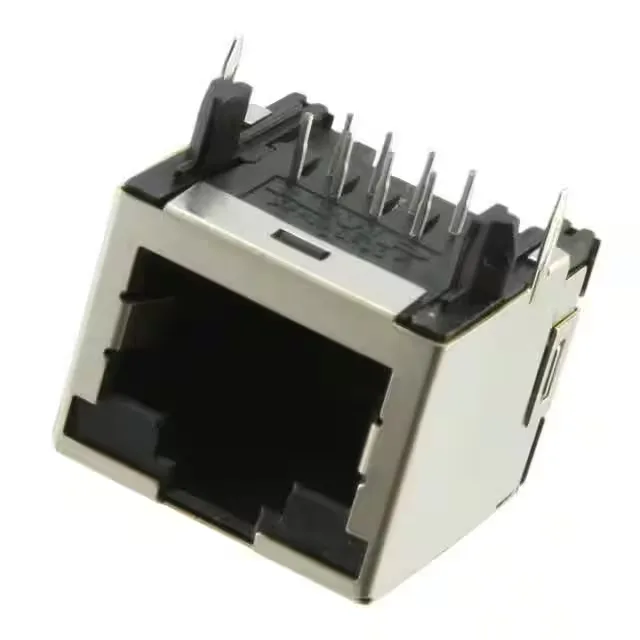
It sits in TE's 406541 series of shielded jacks, distinguished here by the EMI finger on the shield and the 50.0µin (1.27µm) gold contact finish. The right-angle orientation and through-hole termination place the jack perpendicular to the PCB, which is the typical layout for a board-edge Ethernet port on a network switch, industrial controller, or telecom line card.
Shielding and Contact Finish — the Selection Drivers
The shielded body with an integrated EMI finger is the feature that decides the application. That makes this jack the right pick for equipment that must pass radiated-emissions testing — think a PLC, a PoE injector, or a medical monitor. A thinner gold flash would wear through sooner, exposing the base metal and risking intermittent contact. The jack does not contain an LED indicator. If the design needs link/activity lights integrated into the port, look at a sibling with the LED option; this variant keeps the bill of materials simpler and the signal path cleaner.
Mates with any standard 8p8c RJ45 plug terminated to Cat5 or Cat5e solid or stranded cable. Termination is solder-only: the through-hole leads are designed for wave or hand-solder assembly.
Active Part — Sourced to Order
There is no last-time-buy notice or successor part — this is a current-production jack available through the independent distribution channel.
How It Differs from the 1-406541-4
The most common cross-shop question on this base number is the difference between the -5 and the -4 suffix. Both are 8p8c right-angle shielded jacks from the same 406541 family. The -5 includes the EMI finger on the shield; the -4 does not. If the application requires conducted emissions to be drained to chassis ground through the connector shell, the -5 with the EMI finger is the correct part. For a simple ungrounded shielded jack in a metal enclosure where the shield contacts the panel directly, the -4 may suffice. The pinout, footprint, and gold plating thickness are otherwise identical.