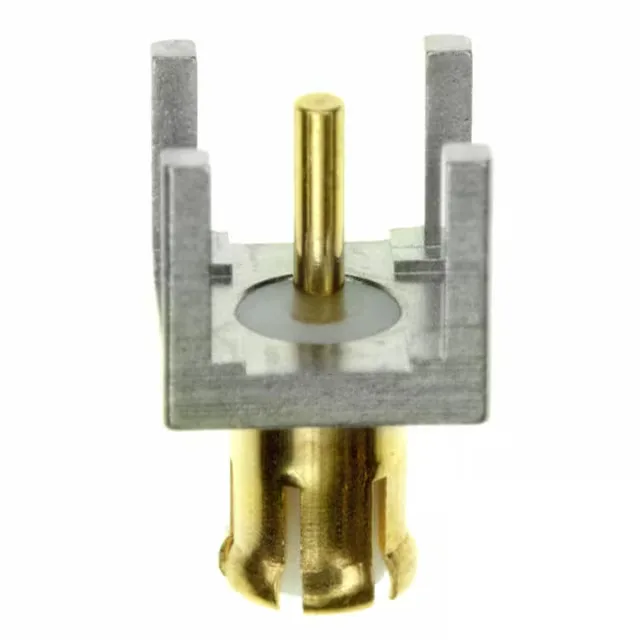
The 1061015-1: The snap-on fastening gives a positive tactile lock when mated — no coupling nut to torque, no threads to cross. Rated to 4 GHz max frequency with 0.1 dB insertion loss, this connector suits RF modules, test points, and antenna feeds where board space is tight and the signal needs a clean launch through the board edge. PTFE dielectric between center and outer conductor gives the 50 Ohm impedance stability and supports the 335 V rating. The brass body gets a nickel finish; the housing color is silver. The through-hole solder termination and shield solder tab anchor it to the PCB for vibration resistance.
The 4 GHz max frequency covers L-band, S-band, and lower C-band applications; above 4 GHz the insertion loss and return loss degrade beyond the MCX interface's design envelope. 500 mating cycles is a solid mid-range spec for a snap-on connector. The gold-on-beryllium-copper center contact wears gradually — after 500 cycles the contact resistance may shift, but the connector is not designed for thousands of test-bench insertions. For a production RF module that mates once in the field, this is more than adequate. The 0.1 dB insertion loss is measured at the design frequency — it tells you the signal passes through the connector with minimal attenuation. In a cascade of several connectors (e.g., antenna feed + jumper + module), these losses add up; budget accordingly. 335 V rating is high for a subminiature RF connector. The PTFE dielectric provides the creepage and clearance; in practice, the voltage limit is rarely the constraint in a 50 Ohm system where signal levels are millivolts to a few volts. The rating matters for bias-tee or DC-injection applications where RF and DC share the same path.