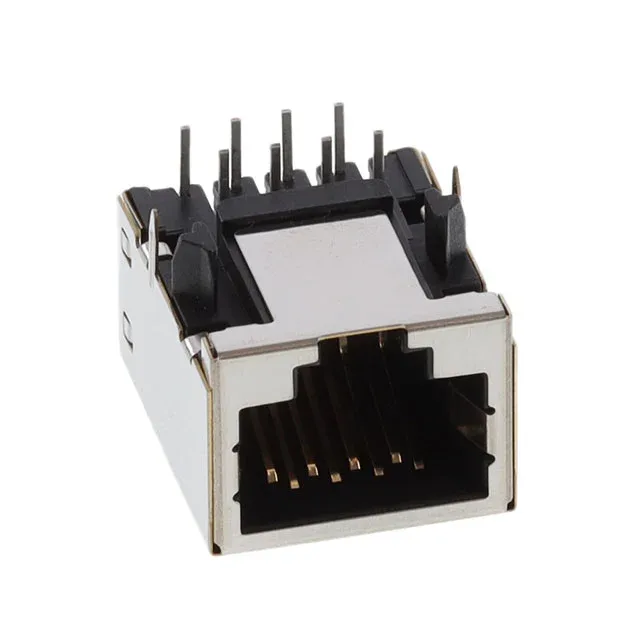
It carries a Cat5 rating, which means it is specified for 100 MHz signaling — the common baseline for 100BASE-TX and 1000BASE-T Ethernet in office and light industrial environments.
This jack mounts through a board edge cutout and secures with through-hole solder tails. The right-angle orientation (90°) with the tab facing down keeps the patch cable exit low against the PCB, which matters when the port sits behind a panel cutout with limited vertical clearance. A board guide on the connector body helps align the jack during assembly — without it, the shield fingers can catch on the cutout edge and bend before the tails seat in the plated holes. The single-port, single-row layout is standard for discrete RJ45 jacks. The EMI finger on the shield contacts the chassis ground plane around the cutout, completing the Faraday cage around the signal pair.