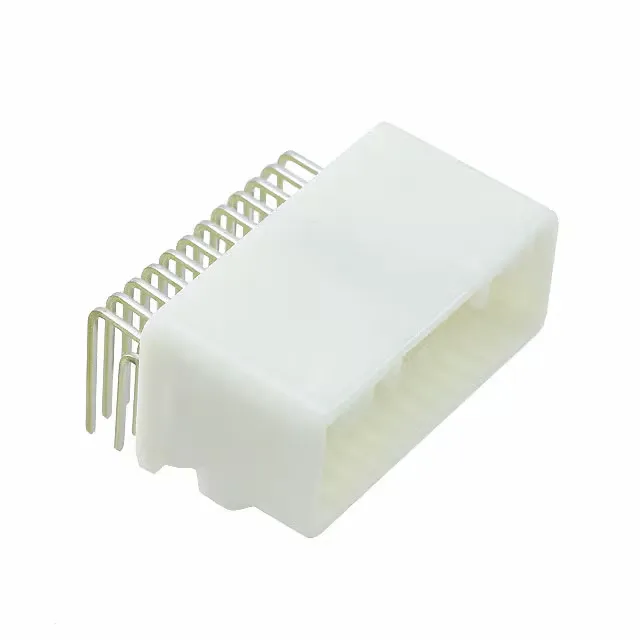
It uses a 0.087" (2.20mm) pitch, which spaces the contacts tightly enough for a compact harness but leaves room for the 20-24 AWG wire typical of this class. The housing is black PBT (Polybutylene Terephthalate), rated for -30°C to 100°C operation — suited for industrial cabinets, automotive interior, and outdoor telecom enclosures where the connector sees ambient heat but not direct engine-bay soak.
Locking ramp and TPA — why they matter for a field-service harness
The 1318801-1 uses a locking ramp for fastening — a positive latch that clicks when fully mated, giving tactile feedback the field tech can feel through gloves. More important is the Terminal Position Lock (TPA) feature: a secondary retainer that locks each crimped terminal into its cavity after insertion. Without TPA, a partially seated terminal can push back during mating and leave an open circuit that is a nightmare to trace in a bundled harness. The TPA turns that into a process check — if the TPA does not slide home, a terminal is not fully seated.
At 7 positions and a 2.20mm pitch, this receptacle sits between the 5-position hybrid (1379217-6, which mixes 3 signal + 2 power contacts in a single row) and the larger 30-position dual-row 1-2333134-5. The 7-position count is a common fit for sensor harnesses and actuator interfaces where you need a few power and signal lines in one connector body. The 2.20mm pitch is tighter than the 3.30mm row spacing on the dual-row sibling, so the wire bundle stays narrower — a real advantage when routing through a 16mm grommet.