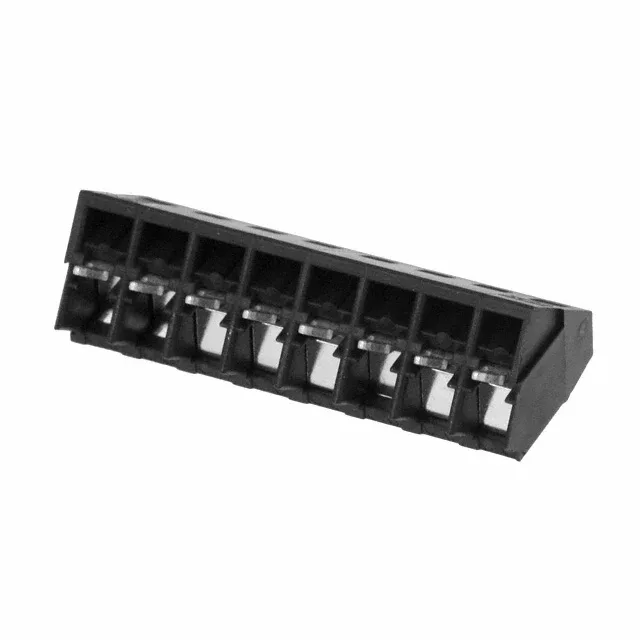
The 1546074-8: It carries a 17.5 A current rating at 300 V, which puts it in the power distribution class — sized for feeding individual loads from a board-level bus, not for signal-level wiring. The rising cage clamp termination (screw-driven clamp that pulls a cage up against the wire) gives a gas-tight connection that holds up under thermal cycling better than a simple screw-and-plate design. Wire acceptance spans 12 AWG down to 30 AWG, so a single block handles both the main feed and the smaller control wires in the same assembly.
Wire Entry at 35° — a Space-Saving Detail
The wire termination orientation is 35° (145°) relative to the board plane, meaning wires approach the block at a shallow angle rather than standing straight up. That matters when the enclosure lid clearance is tight — you gain about 10-15 mm of headroom compared to a vertical-entry block. The interlocking side feature lets multiple blocks snap together side-by-side into a continuous strip, so a 16- or 24-position assembly is just two or three of these 8-position units ganged together, no DIN rail or separate jumper bar required.
Installation Specs That Matter on the Bench
The clamp and screw are both brass with nickel plating, which resists corrosion in humid cabinet environments. The housing is polyamide (PA66) nylon 6/6 — a standard UL94 V-2 rated material for this class of terminal block, though the specific flame rating isn't listed in this entry. The published torque spec is 0.79 Nm (7.0 Lb-In) — that's the value to set your screwdriver clutch to; overtightening strips the M3 screw thread in the nylon housing. Contact plating is brass with tin, adequate for the rated current but not intended for frequent re-termination cycles — tin-on-tin connections cold-weld slightly on first mate, so a wire inserted and torqued should stay put.