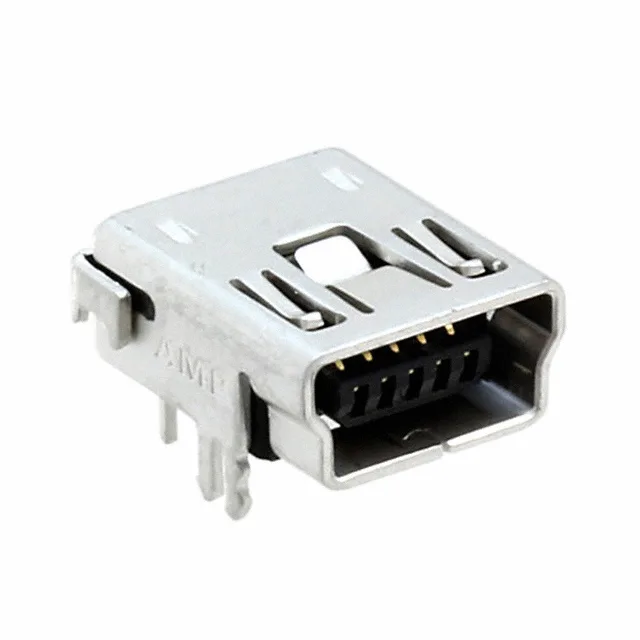
USB Mini B Receptacle for Panel-Mount or Board-Edge Integration
It's the mating half for the standard USB mini B plug found on countless portable devices, cameras, and data cables — a connector that's still widely deployed in embedded systems, test fixtures, and industrial peripherals despite the shift to USB-C in consumer gear.
Layout and Termination — What Fits on the Board
The horizontal mounting feature means the cable exits sideways, which is useful for tight enclosures where a vertical USB port would block airflow or clash with a cover. The board lock consists of two additional through-hole posts that get soldered — they're not signal paths, just mechanical anchors that resist the lever force when a cable is plugged or yanked. The 5 contacts follow the standard USB mini B pinout: VBUS, D-, D+, ID, and GND. The ID pin is left unconnected in most applications, but on a mini B receptacle it's physically present for the full 5-position count.
Signal and Power Ratings — USB 2.0 Duty
Rated 1 A at 30 VAC, this connector is sized for USB 2.0 power delivery — enough for device charging at 5 V up to the 1 A mark, but not for USB 3.0's higher data rates or the power-hungry fast-charge protocols. The USB 2.0 specification (rated data rate 480 Mbps) is the signal envelope here; the connector itself doesn't limit the data rate as long as the PCB trace impedance and cable assembly are designed for it.