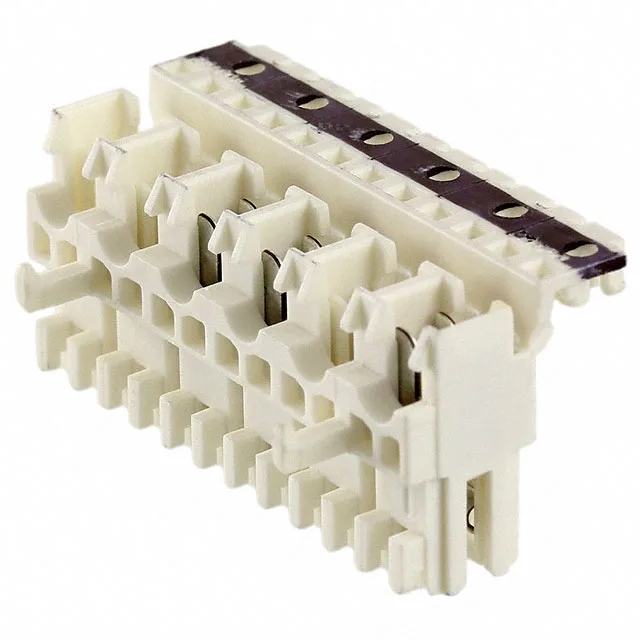
It uses a female blade socket contact finished in tin, and the housing is natural (uncolored) UL-rated material. This connector is built for free-hanging, right-angle wire exit, meaning the cable routes perpendicular to the connector body, which helps in tight enclosures or along a board edge.
Sizing the Termination — IDC on Discrete Wire
IDC termination on discrete wire (not ribbon cable) is the defining feature here. Each wire is pressed into its own IDC slot in the housing, displacing insulation to make contact with the tin blade. This avoids crimping individual terminals and speeds up harness assembly — but the wire gauge range must match the slot geometry. The connector accepts discrete wire, so you are not limited to a fixed ribbon pitch; each position can be wired independently. The right-angle wire exit means the cable bundle turns 90° immediately after the connector, which is useful when the mating header is near a panel wall or another component.
Mating and Locking — What It Connects To
This receptacle mates with a DuoPlug header that has a matching locking ramp feature. The locking ramp engages on insertion and requires a deliberate pull or tool release to un-mate — it is not a friction-only fit. For a harness that will see field service, the locking ramp gives a tactile confirmation that the connector is fully seated.