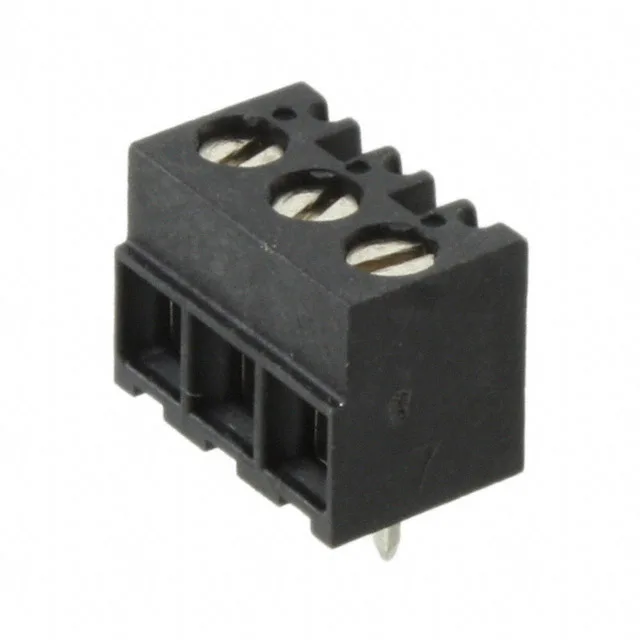
3-Position PCB Terminal Block, 0.150" Pitch
The TE Connectivity Buchanan 1776113-3 is a 3-position, single-level PCB terminal block from the Buchanan series, designed for wire-to-board termination on a printed circuit board. It uses a screw-actuated rising cage clamp to secure 16-28 AWG wire against a tin-plated copper alloy contact, with the wire entry oriented horizontally with the board — a layout that keeps the wiring parallel to the PCB plane for tighter enclosure fit. The 0.150" (3.81mm) pitch spaces the three positions enough to handle the 150 V / 12 A rating without forcing a wide board footprint, and the polyamide (nylon) housing carries a -40°C to 110°C operating range, suited for industrial control cabinets and HVAC equipment where the terminal block lives inside an enclosure with no direct moisture exposure.
The 12 A per-position rating is the block's maximum continuous current at the rated voltage of 150 V. For a 3-circuit block, that means 12 A per circuit individually, not summed — each terminal carries its own load. The 150 V is the max working voltage between adjacent positions or to ground; for most low-voltage control circuits (24 VDC, 120 VAC) this is generous headroom. The wire gauge range of 16-28 AWG covers common field wiring: 16 AWG for power feeds up to the full 12 A, 18-20 AWG for typical control signals, and 22-28 AWG for smaller sensor loops. The tin-plated contact is adequate for the rated current and the moderate mating cycle count of a screw-clamp terminal — the clamp force, not the plating, carries the current.
Screw Rising Cage Clamp Termination
The rising cage clamp works by turning the screw to lift a nickel-plated copper alloy clamp plate inside the housing, trapping the stripped wire between the plate and the current bar. It does not require a ferrule, though one can help with fine-stranded wire. The screw and clamp are both nickel-plated copper alloy, which resists corrosion in the typical industrial cabinet environment. The through-hole solder pins anchor the block to the PCB — the screw torque is applied after soldering, so the board must be supported to avoid lifting the pads.