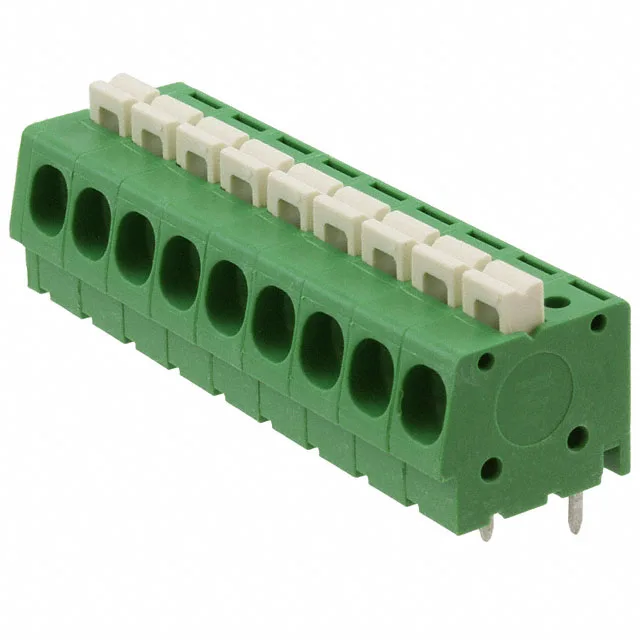
What This 9-Position Terminal Block Does on a PCB
The 1986711-9: The green polyamide housing accepts wires from 12 AWG down to 30 AWG through a screwless push-button clamp — push the orange button, insert the stripped wire, release. The clamp holds the conductor against a tin-plated copper alloy contact bar, rated for 16 A per position at 300 V. The side interlocking feature lets you snap multiple blocks together to build a wider terminal strip without extra hardware — useful when your BOM calls for 18 or 27 positions on the same board edge.
Where This Terminal Block Fits in the Panel
The 16 A and 300 V ratings put this block squarely in industrial control and building automation duty — PLC output modules, relay boards, motor starter auxiliaries, and HVAC controller interfaces. The -40°C to 110°C operating range covers unheated outdoor cabinets and the warm interior of a panel with transformers or power supplies. Side-entry orientation is the key layout advantage here — the wires run flat along the board, not sticking up. That matters when the enclosure depth is tight, or when you're routing wire bundles to a cable duct mounted above the PCB. The through-hole pins anchor the block to the board; the push-button clamp takes the termination force off the solder joints.
Wire Range and Termination — What the Push-Button Clamp Handles
The push-button clamp accepts 12 AWG to 30 AWG solid or stranded wire. That's a wide span — 12 AWG for power distribution tails, 18 AWG for control wiring, 24 AWG for signal lines. The steel clamp material holds its spring force over repeated actuations; the tin-plated copper alloy contact gives a reliable gas-tight connection on stripped copper. No screwdriver needed — push the button, insert the wire to the full strip length, release the button. The clamp self-adjusts to the wire diameter.
The 1986711-9 is listed as Active on the TE Connectivity lifecycle record, with RoHS compliance confirmed. There is no announced end-of-life or last-time-buy date. No direct stock-holding claim is made here — the supply posture is quoted to order.