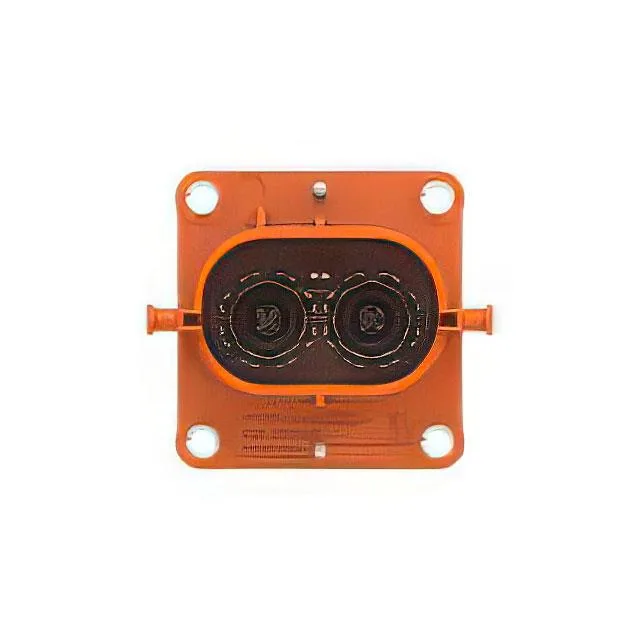
The 2-2141227-1: The orange housing carries a cap (cover) and a mounting flange, and the connector is listed as sealed — meaning it is built to keep moisture and debris out of the panel opening when mated. The silver contact finish, unusual for a discrete-wire connector, gives good conductivity and oxidation resistance in environments where tin or gold might not be specified. This is not a general-purpose in-line splice; it is a panel-feedthrough or bulkhead connector for a power or signal pair that needs to pass through an enclosure wall and stay put.
Panel Mount and Sealing — What the Specs Tell You
Panel mount with a mounting flange means this connector bolts or screws into a cutout — the flange takes the strain of the cable, not the contacts. The push-pull fastening lets you mate and unmate by hand without tools, which is common for field-serviceable connections. The sealed feature, combined with the cap, tells you the connector is meant for an environment where the panel opening needs protection when unmated — think industrial cabinets, outdoor telecom enclosures, or agricultural equipment. The orange colour is a visual key for the assembly line or field tech, often used to denote a specific circuit function or voltage class.
Cable termination is solder — each male pin is soldered to a discrete wire. No crimp tool or IDC applicator needed; this is a hand-solder or wave-solder joint at the wire end. The wire type is discrete, so you are running individual conductors, not ribbon cable. For the harness builder, that means stripping, tinning, and soldering each wire to the pin, then inserting the pin into the housing if it is a separate contact — the spec lists male pin as the contact type, so the pin may be integral to the housing or a separate solder-cup terminal. Given the panel-mount flange and sealed cap, this connector is typically wired before being fastened into the panel.