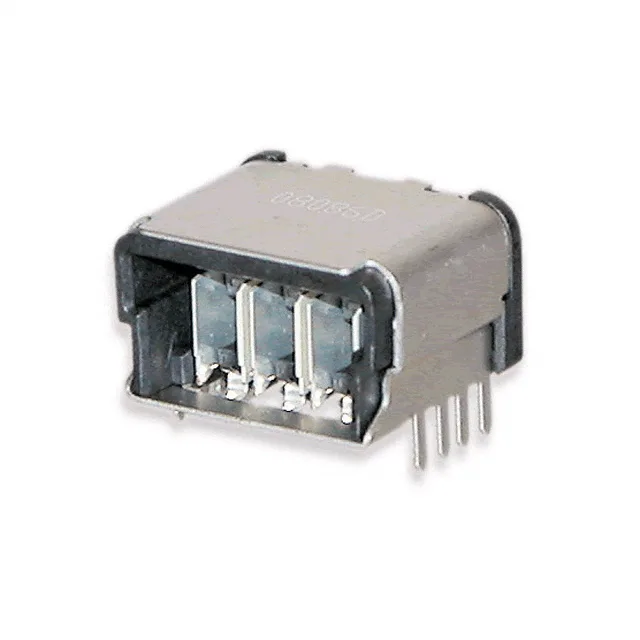
The TE Connectivity 2016032-1 is a QSL three-port receptacle, a non-gendered RF interconnect designed for board-level coaxial signal routing. It sits in the QSL connector family, a push-pull, quick-lock interface used where a compact, blind-mateable RF connection is needed — typically on wireless infrastructure, small-cell radio heads, and test equipment. The 50 Ohm impedance and DC-to-6 GHz bandwidth cover sub-6 GHz cellular bands, GPS, Wi-Fi, and ISM applications.
The 6 GHz frequency ceiling means it handles the full sub-6 GHz spectrum cleanly; above that, insertion loss and VSWR rise beyond the design window. Insertion loss is rated at 0.4 dB across the band, which is tight enough that the connector won't eat into your link budget on a short cable run. The connector is specified for RG-174 cable groups — a 50 Ohm flexible coax type used in pigtail assemblies and patch cords. The push-pull fastening means no threads to cross or torque to verify; it snaps home and pulls straight off. The tin-plated centre contact and steel body with tin finish are adequate for indoor or sheltered environments, but not for outdoor exposure without additional sealing.
This receptacle uses a hybrid mounting approach: surface-mount pads for the signal launch combined with through-hole posts for mechanical retention. The shield termination is solder — the outer conductor of the coax solders to the ground pads on the PCB, which also anchor the connector body. The centre contact terminates via solder to the PCB trace. The Tape & Reel packaging confirms this is intended for reflow assembly on a pick-and-place line, not hand-soldering in the field.
The closest parametric peer in the ledger is the 1057230-1, a 1-port OSP jack with gold plating and 22 GHz bandwidth, but it is a different connector interface (snap-on OSP vs push-pull QSL) and not a functional substitute.