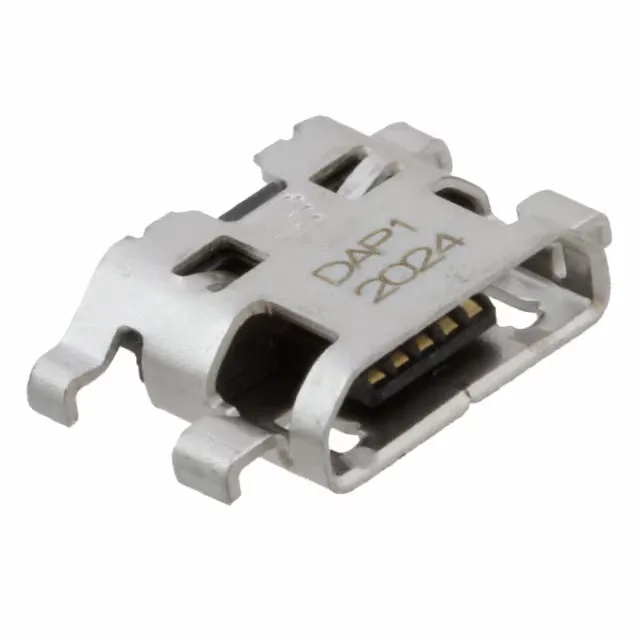
The 2134441-2: It carries 5 contacts (the standard micro-B count for USB 2.0 signal plus ID pin) and is rated for USB 2.0 data rates, so it handles the full-speed and high-speed signalling common in phone, tablet, and IoT module interfaces. The mid-mount reverse orientation means the contacts sit flush with the board edge, letting the cable route horizontally rather than protruding above the PCB — a common requirement in sealed enclosures or devices with a thin profile.
Mounting and Termination — Board Layout Notes
Surface-mount, right-angle receptacle with a board cutout mounting feature. The 'Horizontal, Mid Mount, Reverse' description tells the layout engineer that the connector sits on the edge of the PCB and the contact tails face the board surface.
Mating Cycles and Contact Plating — What 10,000 Cycles Means
The 10,000 mating cycle rating is at the high end for a USB micro-B connector. For a device that gets plugged in daily — a test fixture, a handheld scanner, a medical monitor — the cycle life is the limiting factor, not the current rating.
Current and Voltage — The USB Power Contract
The current rating is listed as 0.5A, 1A, 1.8A per contact — these correspond to the USB 2.0 power delivery levels: 100 mA for low-power devices, 500 mA for standard USB 2.0 ports, and 1.8 A for dedicated charging ports. The connector itself can handle the 1.8 A level, but the actual current the contact carries depends on the host port's power negotiation and the cable's wire gauge. The 30V rating is typical for a USB connector — well above the 5V bus voltage, so the margin covers any transient spikes from hot-plug events or inductive kick from the cable.
The connector is ROHS3 compliant. The lifecycle status is Active.